Connect with us

General News

Slave Wages: INEC Pays Adhoc Staff Insulting N1,500 Per Day as Transport, Feeding, and Training Allowance for FCT Council Election

Published

on

Onoja Baba

The Independent National Electoral Commission (INEC) has come under fire for disbursing what adhoc staff describe as a peanut amount of N1,500 per day as transport fare, feeding, and training allowance during the February 21, 2026, Federal Capital Territory (FCT) Area Council elections.

This minimal daily rate left many of the temporary workers, including National Youth Service Corps (NYSC) members, financially strained and deeply dissatisfied after enduring intense physical and logistical demands to facilitate the polls across six area councils.

SecretsReporters has learned that only N10,500 was ultimately paid to corps members and other adhoc staff who served in the election. This total covered three days of rigorous training from 9 AM to 5 PM each day, plus election day responsibilities that included passing a night on bare floors, tables, and mats at collation or duty centers, followed by opening polling booths as early as 7:30 AM. Payments consisted of N6,000 in cash handed out on election day and N4,500 transferred to accounts four days later, with no further communication from INEC indicating if additional funds would be forthcoming.
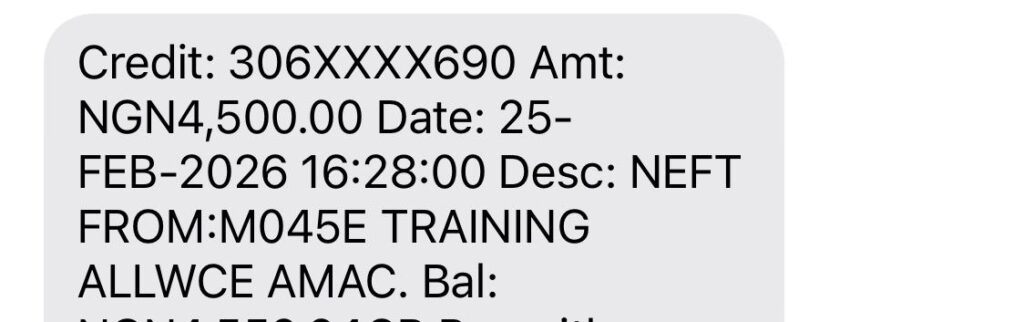
With no further communication from INEC regarding additional disbursements, many participants feel shortchanged and abandoned. One NYSC member, speaking anonymously to SecretsReporters, expressed profound regret over her involvement. “I regretted participating in the election as the stress does not worth it,” she said.

She detailed leaving her home around 2 PM the day before the election to report to the Registration Area Center (RAC), enduring a night on bare floors, tables, or mats, and then opening her polling booth by 7:30 AM on election day. Her ordeal ended only when she returned home around 10 PM that evening, exhausted and disillusioned.

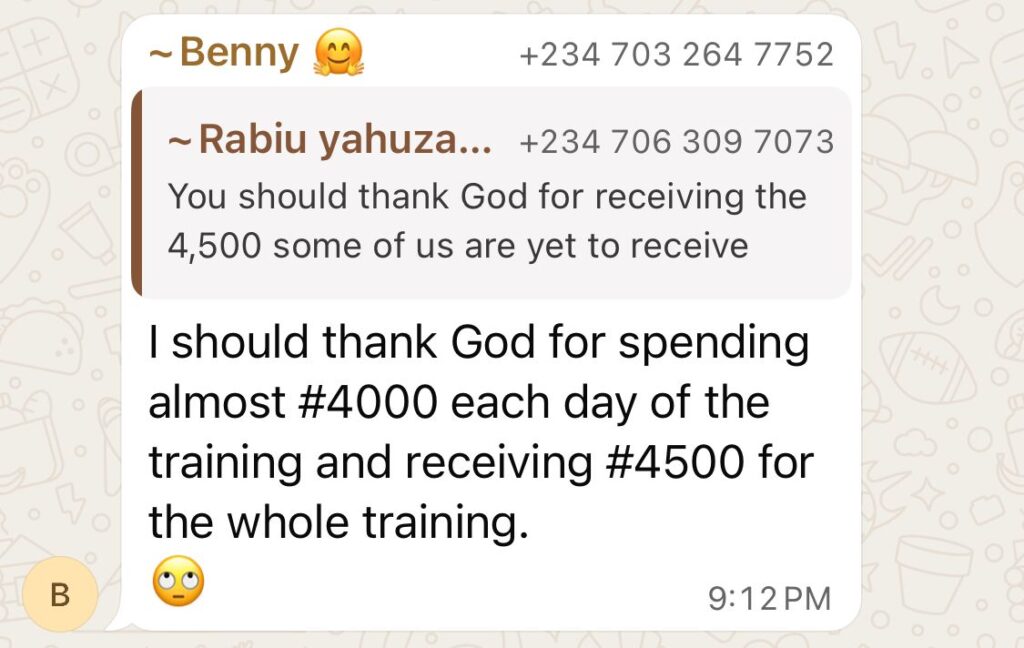
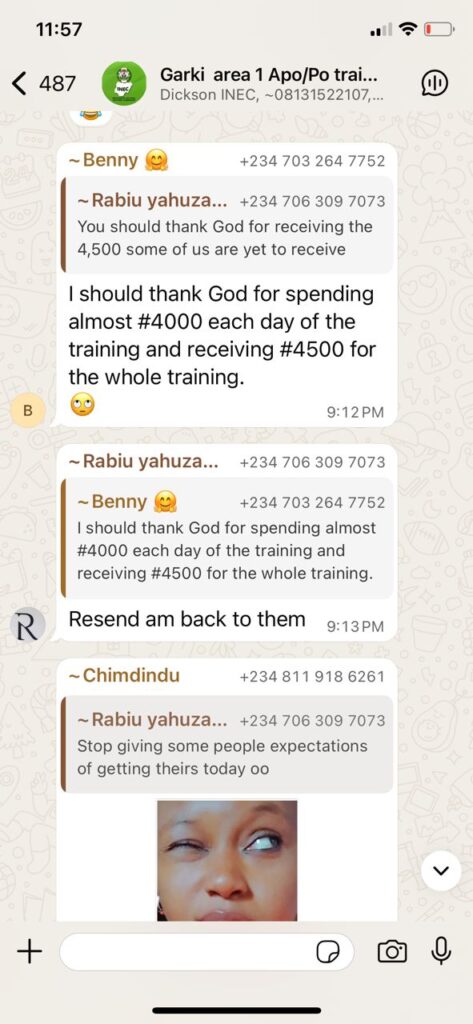
The training itself was no less demanding, spanning three days from 9 AM to 5 PM each session, where staff were drilled on electoral procedures under often uncomfortable conditions. Yet, the N4,500 allocated for this phase barely covered personal expenses, as highlighted by several participants. One adhoc worker, who was trained at the Area 1 Primary School AMAC, spending nearly N4,000 daily on transport alone to attend the sessions, only to receive a total of N4,500 for the entire training, effectively netting a loss, lamented in their WhatsApp group seen by SecretsReporters. “I should thank God for spending almost N4,000 each day of the training and receiving N4,500 for the whole training,” the worker stated sarcastically, underscoring the financial strain amid Nigeria’s rising living costs.

This discontent is amplified by queries from staff about outstanding payments. In group discussions among participants, one queried, “Are we still expecting Election Day payment from INEC? I thought the 6k cash that day was just feeding and transportation.” Such uncertainties persist without official clarification, fueling speculation that the N10,500 represents the full compensation.

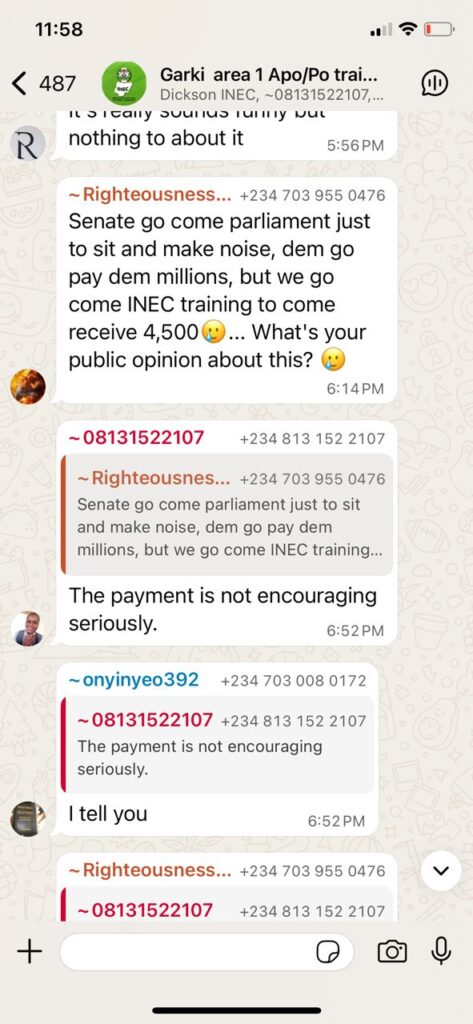
Another participant compared the stress they faced to the job of the Nigerian Senate and the obvious disparity in compensation. He said, “Senate go come parliament just to sit and make noise, dem go pay dem millions, but we go come INEC training to come receive 4,500.” This comment highlights the perceived disparity where elected lawmakers receive substantial monthly salaries and allowances, often running into millions of naira, while adhoc staff, including youth corps members who endure grueling training and election duties, are compensated with a mere N4,500 for days of effort.

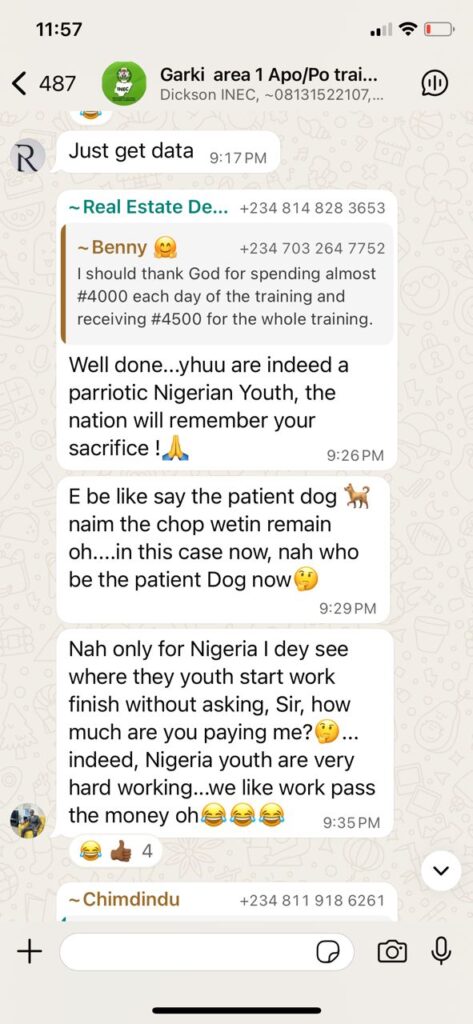
One of the adhoc staff highlighted the striking willingness of Nigerian youth to commit to demanding electoral duties without first inquiring about compensation, reflecting a deep sense of patriotism and hard work. As one participant put it, “Nah only for Nigeria I dey see where they youth start work finish without asking, Sir, how much are you paying me?… indeed, Nigeria youth are very hard working…we like work pass the money oh.” This sentiment underscores a pattern where dedication to national service often precedes any discussion of fair pay, with participants enduring rigorous training and long hours driven more by a sense of duty than by expectations of adequate reward.
This low compensation highlights a stark contrast with INEC’s substantial budgetary allocations for electoral activities. The commission proposed N171 billion for its 2026 operations, including the FCT Area Council polls, by-elections, and off-cycle governorship elections in states like Ekiti and Osun. The breakdown includes N109 billion for personnel costs, N18.7 billion for overheads, N42.63 billion for election-related activities, and N1.4 billion for capital expenditure. This funding supports routine and off-season polls under the newly enacted Electoral Act 2026, which introduces enhancements like electronic result transmission but does not yet reflect a pending NYSC request to raise corps members’ allowances to N125,000 per engagement, potentially adding about N32 billion if approved.

INEC’s larger projections underscore the disparity further. The commission has sought N873.78 billion specifically for the 2027 general elections, with components such as N379.75 billion for operational costs, N209.21 billion for technological upgrades including BVAS and IReV systems, N154.91 billion for capital expenditure, and N42.61 billion for miscellaneous expenses. Earlier proposals for adhoc staff in major elections have included higher figures like N50,000 election duty allowance per corps member plus feeding and training components, yet the FCT implementation fell far short, reinforcing perceptions of undervalued frontline workers.

The FCT polls, covering 68 elective positions across 62 wards, proceeded peacefully but with notably low voter turnout amid logistical hurdles. Adhoc staff played a pivotal role in setup, accreditation, voting, and collation despite challenges like material distribution delays and overnight accommodations. INEC has initiated probes into some operational shortfalls but has not publicly addressed the widespread grievances over allowances.

SecretsReporters contacted INEC for clarification on the adhoc staff payments, the rationale behind the N1,500 daily rate, and any plans for supplementary disbursements, but received no response by publication time.

As Nigeria prepares for more elections, including upcoming governorship polls and the 2027 general elections, these experiences raise critical questions about the sustainability of relying on adhoc personnel under such compensation structures.

Speaking on the situation, the Network Against Corruption and Trafficking, NACAT, told SecretsReporters that without meaningful reforms to ensure fair, timely, and adequate pay, the commission risks eroding morale among the essential workforce that upholds electoral integrity at the grassroots level.
Continue Reading
Click to comment

Leave a Reply

Your email address will not be published. Required fields are marked *

General News

Army Builds Schools, Town Halls as Questions Grow Over Nigeria’s Deepening Security Crisis

Published

on

Secrets Reporters

As Nigeria continues to battle kidnappings, banditry, insurgency and violent attacks across several states, the Nigerian Army has shifted part of its public engagement toward community development, unveiling schools, town halls, boreholes and other infrastructure under its Civil-Military Cooperation (CIMIC) programme.


The Army says it has now completed more than 250 intervention projects nationwide, including schools, hospitals, roads, ICT centres, solar-powered facilities and water projects. The announcement came during the 163rd Nigerian Army Day Celebration (NADCEL 2026) in Rivers State, where Chief of Army Staff, Lieutenant General Waidi Shaibu, commissioned four new projects across the state’s three senatorial districts.


According to SecretsReporters‘ analysis, the Army’s expanding role in providing public infrastructure reflects a significant evolution in its relationship with civilians. While such interventions may improve public goodwill, they also expose a difficult reality: many communities are celebrating projects that ordinarily fall within the constitutional responsibilities of local, state and federal government institutions.


SecretsReporters further observes that although schools, boreholes and community halls can improve the lives of residents, they cannot replace the primary expectation Nigerians have of the military protecting lives, securing communities and restoring confidence in areas where criminal violence has become routine. Across many parts of the country, citizens continue to measure security agencies not by the number of projects commissioned but by whether they can travel safely, farm without fear and sleep without the threat of attacks.


The four projects commissioned in Rivers include the renovation of Community Secondary School, Obio/Akpor, Community Secondary School in Lueku, Khana Local Government Area, the reconstruction of a Community Town Hall in Oyigbo Local Government Area and the installation of a solar-powered borehole in Degema Local Government Area.


Speaking during the commissioning, Lieutenant General Shaibu said the projects demonstrate the Army’s commitment to complementing military operations with initiatives that directly improve the lives of citizens. He argued that lasting national security cannot be achieved through military action alone and described the Army’s Civil-Military Cooperation programme as a strategic platform for building confidence between soldiers and host communities.


The Army Chief disclosed that more than 250 intervention projects have now been completed across Nigeria, covering hospitals, classroom blocks, roads, ICT centers, solar lighting systems and water supply facilities. He urged benefiting communities to protect the projects and acknowledged President Bola Ahmed Tinubu for supporting the Army’s operational activities.
Earlier, the Chief of Civil-Military Affairs, Major General Musa Etsu-Ndagi, said the Rivers projects were deliberately distributed across the state’s three senatorial districts to ensure wider community impact.


Chairman of Obio/Akpor Local Government Area, Honourable Gift Worlu, welcomed the intervention, describing the renovated schools as a boost to education within the council.
For SecretsReporters, however, the larger issue extends beyond the ribbon-cutting ceremony. The growing visibility of military-led community projects raises broader questions about governance, institutional boundaries and public accountability. While civil-military cooperation is recognized globally as a tool for strengthening trust between armed forces and civilians, it is not designed to substitute for effective governance or diminish the military’s constitutional responsibility to defend the country.


The latest intervention also comes at a time when security remains one of Nigeria’s most pressing national concerns. In several parts of the country, communities continue to experience attacks by armed groups, while thousands of citizens have been displaced and economic activities disrupted by persistent insecurity.

Continue Reading

General News

Emem Usoro Scandal: Journalist Stanley Ugagbe Remanded in Kuje Prison Over Cybercrime Charges

Published

on

Secrets Reporters

Journalist Stanley Ugagbe has been remanded at the Kuje Correctional Centre by the Federal High Court in Abuja following his arraignment on a six-count charge filed by the Inspector-General of Police over publications concerning the Deputy Governor of the Central Bank of Nigeria (CBN), Emem Usoro.

Ugagbe was arraigned before Justice Salim Olasupo Ibrahim on Monday morning, where the charges were read to him. Following the proceedings, the court ordered that he be remanded in the Kuje Correctional Centre and adjourned the case until September 21st for trial.

The development marks the latest chapter in a case that has drawn attention from journalists and press freedom advocates nationally and internationally following Ugagbe’s arrest and detention by the Nigeria Police Force.

The charges stem from criminal proceedings instituted by the Inspector-General of Police before the Federal High Court in Abuja, accusing Ugagbe and Fejiro Oliver of conspiracy, cyberstalking and defamation arising from a series of reports titled “Exclusive: CBN Deputy Governor Emem Nnana Usoro Hides N1.4 Billion California Luxury Condo in Asset Declaration Scandal – Part 1”; “EXCLUSIVE: CBN Deputy Governor Emem Usoro Linked to N3.6bn Los Angeles Property Amid Questions Over Asset Declaration Compliance (Part 2)” published on SecretsReporters.

According to the charge sheet, the prosecution alleged that the defendants conspired to commit cyberstalking contrary to the Cybercrimes (Prohibition, Prevention, etc.) Act, 2015 (as amended in 2024). The police further accused Ugagbe of publishing stories alleging that the CBN deputy governor concealed a luxury property in California in her asset declaration, was linked to a multi-billion naira property in Los Angeles, and published another report concerning her personal life. The prosecution contended that the publications were false and constituted cyberstalking and defamation under the Cybercrimes Act and the Penal Code.

With the court now ordering his remand at the Kuje Correctional Centre, Ugagbe will remain in custody pending the next hearing, which has been fixed for September. The court is expected to consider issues relating to his bail and continue proceedings on the substantive charges at the adjourned date.

Recall that Ugagbe’s ordeal began on July 1, 2026, when armed men reportedly abducted him on his way home from work. The operatives confiscated his mobile phones and laptop before taking him away in an unmarked vehicle. For several days, neither his family nor his employer knew his whereabouts.

His disappearance sparked widespread condemnation from media organizations, including the Nigeria Union of Journalists (NUJ), which demanded that security agencies disclose his whereabouts, grant him access to his family and legal representatives, and either charge him before a competent court or release him.

International organizations also reacted. The Committee to Protect Journalists (CPJ) called on Nigerian authorities to investigate his disappearance and ensure his immediate safety, while the International Press Institute (IPI Nigeria) intervened in efforts that eventually led to his release from police custody.

Following his release on July 6, Ugagbe was granted bail while police reportedly continued investigating allegations, including espionage, cyberstalking, and other computer-related offences.

Continue Reading

General News

ICPC Probes News Agency of Nigeria Over Alleged Recruitment Irregularities After Secrets Reporters Expose

Published

on

SecretsReporters

The Independent Corrupt Practices and Other Related Offences Commission (ICPC) has commenced an investigation into alleged recruitment irregularities at the News Agency of Nigeria (NAN), seeking records relating to the agency’s employment and staff regularisation exercises conducted between 2024 and 2026.

The development comes days after SecretsReporters publication, titled “Alleged Sexual Harassment, Recruitment Controversy Rock News Agency of Nigeria as Female Employee Questions Grade Level Placement”.

The anti-corruption agency has formally requested a comprehensive range of recruitment and personnel records from NAN as part of an ongoing investigation into possible violations of the Corrupt Practices and Other Related Offences Act, 2000.

In a letter dated July 6, 2026, and addressed to the Managing Director/Chief Executive Officer of NAN, the ICPC directed the agency to produce the requested documents and designate a competent officer to appear before investigators at the Commission’s headquarters in Abuja.

The letter, signed by the Director of Operations on behalf of the Chairman of the ICPC, stated that the request was made pursuant to Section 38 of the Corrupt Practices and Other Related Offences Act, 2000, which empowers the Commission to obtain documents and information required for the purpose of investigations.

According to the letter, investigators requested all records relating to NAN’s recruitment and staff regularisation exercises between 2024 and 2026.

The Commission specifically requested recruitment advertisements, eligibility and selection criteria, lists of shortlisted applicants, names of successful candidates, and minutes of meetings of committees involved in the recruitment process.

The ICPC also requested the personnel file of Ogunola Folashade Adunni, together with any additional information that could assist investigators in determining whether due process was followed during the recruitment exercise.

Part of the letter reads: “This Commission is investigating an alleged violation of the Corrupt Practices and Other Related Offences Act, 2000 and it has become necessary to obtain certain documents/information from your office.”

It further directed NAN to ensure that a competent officer appeared before investigators with all relevant recruitment and personnel records requested by the Commission.

Continue Reading

Trending

Support Independent News