
Connect with us

General News

NACAT Partners EFCC, ICPC To Campaign Against Corruption in Abuja

Published

on

NACAT

SECRETS REPORTERS

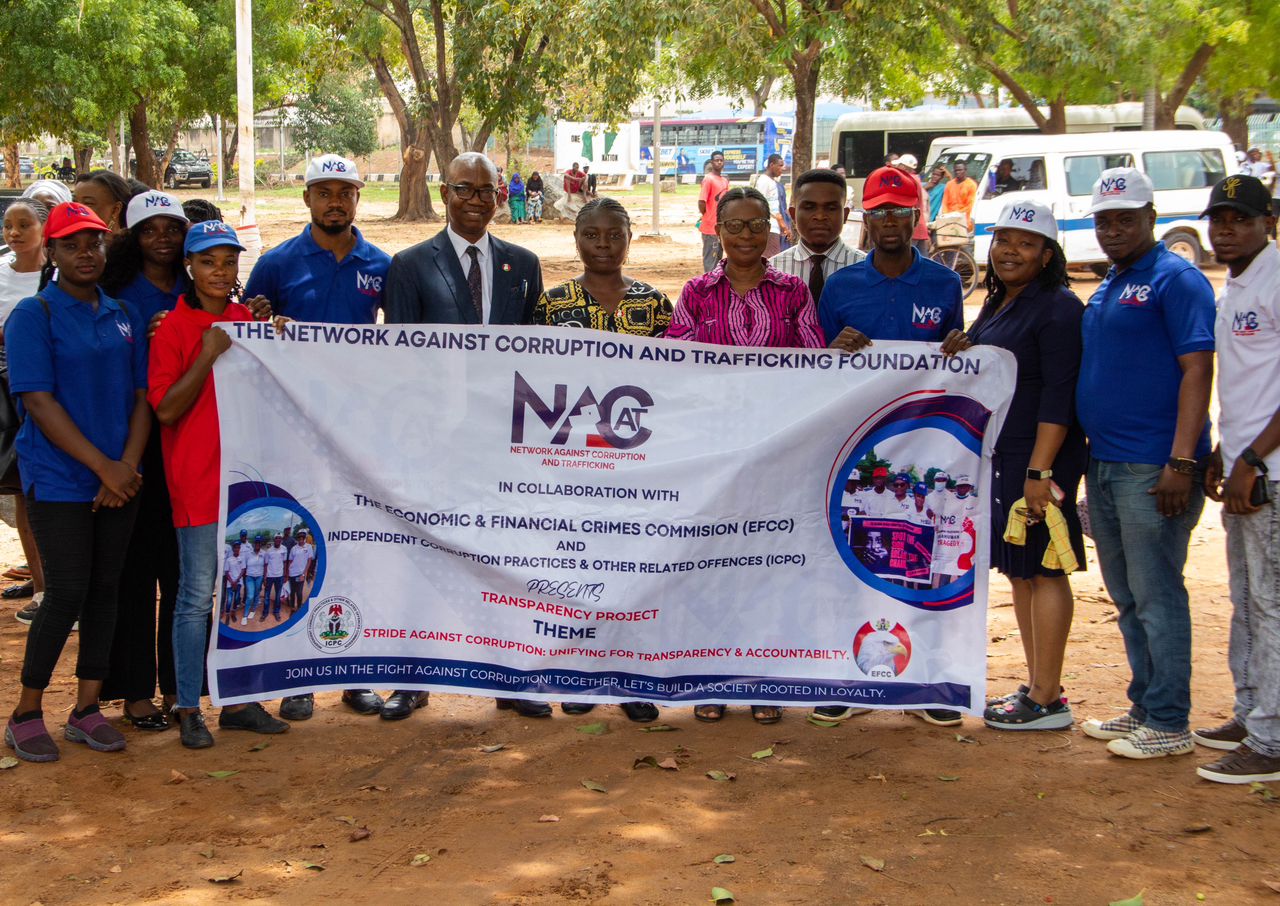
The Network Against Corruption and Trafficking in collaboration with the Economic and Financial Crimes Commission (EFCC) and the Independent Corrupt Practices and Other Related Offences Commission (ICPC) Wednesday, held a campaign against corruption in Abuja.

The event, with the theme, “Stride Against Corruption: Unifying For Transparency and Accountability,” was held at the popular Unity Fountain, in Maitama, Abuja. In attendance were stakeholders from all walks of life including the EFCC, ICPC and the State Security Services.

In his welcome address, NACAT Operational Manager, Stanley Ugagbe averred that the program was in continuation of the group’s contribution to the global fight against the draconian scourge of corruption. While welcoming stakeholders and all the participants, Ugagbe stated that the program is an annual initiative of NACAT.

Harping on “The scourge of corruption and its threat to Nigeria’s progress,” Mrs. Uba Emilia, Assistant Director, Public Private Partnership Unit, ICPC, opined that corruption, “the insidious misuse of power for personal gain, has long plagued our nation, stifling development and eroding the foundations of our society. It permeates every level of our government and society, from high-ranking officials to local bureaucrats”.

Quoting Transparency International, Emilia said Nigeria consistently ranks among the most corrupt countries in the world, “a clear indicator of the magnitude of the problem we face”.

Among others, she said corruption undermines public trust in institutions, stifles economic activities, perpetuates inequality, severely hampers foreign investment, causes brain-drain/human capital flight, threatens development, breeds uneducated and unhealthy citizenry, births weak institutions and reduces life expectancy.

Proffering solutions to the vice, the ICPC personnel stated that the fight against corruption must be a collective effort. “It requires strong leadership, transparent institutions, and an engaged citizenry. Our leaders must demonstrate an unwavering commitment to integrity and accountability. Laws and regulations must be enforced impartially, and those found guilty of corrupt practices must face consequences, regardless of their status or connections.

“Civil society organizations and the media play a crucial role in this fight. They must be vigilant and courageous in exposing corruption and holding those in power accountable. Education is also a vital tool in combating corruption. Technological advancements offer additional avenues to combat corruption. E-governance initiatives, for example, can reduce opportunities for corrupt practices by increasing transparency and efficiency in public administration. Digital platforms for reporting and monitoring corruption can empower citizens and provide real-time data to track the use of public funds.”

On his part, Mr. Tony Orilade, Assistant Director, Head Public Interface Unit, EFCC, who shared insight on “Unmasking the faces of corruption: Exposing the culprits and their tactics,” noted that the fight against corruption is a collective effort. While stressing that the EFCC is relentless in the fight against corruption, he urged Nigerians to report corrupt elements to the commission. “If you see something, say something”.

According to Tony, the commission is always available to act on petitions brought to its table. He stated that the commission is ever ready to guide members of the public on how to properly write a petition, stressing that members of the public can access the commission by visiting their physical offices or through forms and phone numbers on their website.

While fielding questions from participants, Orilade maintained that the commission is not lopsided in its fight against corruption, citing current corruption cases involving a former governor and a former minister who belong to the ruling All Progressives Congress.

Also speaking at the event, NACAT Program Manager, Mrs. Jennifer Idowu who spoke earlier on “Breaking the Cycle of Corruption: Empowering Citizens and Promoting Accountability in Nigeria,” said the time has come to break this cycle and chart a new course for the nation.

To accomplish this, she said by fostering an environment where every Nigerian feels their voice matters, “we can instill a culture of integrity and accountability. Education and awareness are our most potent tools. Let us ensure that every citizen understands the devastating impact of corruption and knows the ways to combat it. This begins with grassroots education programs, community forums, and widespread information campaigns that highlight both the cost of corruption and the benefits of a transparent society”.

In her words, “By joining forces, we can create a culture where honesty is the norm and corruption has no place. Let us stand united, not just in our words but in our actions, to build a Nigeria where transparency and accountability are the foundations of our society. Our combined efforts can turn the tide against corruption and pave the way for a brighter, more equitable future”.

NACAT Policy Analyst, Onoja Johnson Baba who shared insight on “The Cancer of Corruption: How Nigeria’s Political Elite Undermine National Progress,” underscored the Scandal of Sani Abacha, The Petroleum Subsidy Fraud, The Case of Diezani Alison-Madueke and the Nigerian Electoral Process.

In his words, corruption has profound and far-reaching consequences on Nigeria’s development. “It diverts public funds from essential services such as healthcare, education, and infrastructure. It deters foreign investment, as the perceived risk of doing business in a corrupt environment is high. Moreover, it exacerbates inequality, as the elite accumulate wealth while the average citizen remains in poverty”.

To combat this cancer, he said “we must adopt a multifaceted approach. First, there must be a genuine political will to fight corruption at all levels. This includes strengthening institutions such as the Economic and Financial Crimes Commission (EFCC) and ensuring they operate independently without political interference.

“Second, transparency and accountability must be enforced rigorously. Public officials should be required to declare their assets, and there should be stringent audits of government spending. Civil society and the media play a crucial role in this regard by holding leaders accountable and exposing corrupt practices.

“Third, judicial reform is essential. The legal system must be equipped to deal swiftly and effectively with cases of corruption, ensuring that justice is served without undue delay.

“Lastly, we, as citizens and organization, have a role to play. We must demand better governance and refuse to engage in or tolerate corrupt practices in our daily lives. It is only through a collective effort that we can hope to eradicate this cancer from our society,” he said.
General News

Army Builds Schools, Town Halls as Questions Grow Over Nigeria’s Deepening Security Crisis

Published

on

Secrets Reporters

As Nigeria continues to battle kidnappings, banditry, insurgency and violent attacks across several states, the Nigerian Army has shifted part of its public engagement toward community development, unveiling schools, town halls, boreholes and other infrastructure under its Civil-Military Cooperation (CIMIC) programme.


The Army says it has now completed more than 250 intervention projects nationwide, including schools, hospitals, roads, ICT centres, solar-powered facilities and water projects. The announcement came during the 163rd Nigerian Army Day Celebration (NADCEL 2026) in Rivers State, where Chief of Army Staff, Lieutenant General Waidi Shaibu, commissioned four new projects across the state’s three senatorial districts.


According to SecretsReporters‘ analysis, the Army’s expanding role in providing public infrastructure reflects a significant evolution in its relationship with civilians. While such interventions may improve public goodwill, they also expose a difficult reality: many communities are celebrating projects that ordinarily fall within the constitutional responsibilities of local, state and federal government institutions.


SecretsReporters further observes that although schools, boreholes and community halls can improve the lives of residents, they cannot replace the primary expectation Nigerians have of the military protecting lives, securing communities and restoring confidence in areas where criminal violence has become routine. Across many parts of the country, citizens continue to measure security agencies not by the number of projects commissioned but by whether they can travel safely, farm without fear and sleep without the threat of attacks.


The four projects commissioned in Rivers include the renovation of Community Secondary School, Obio/Akpor, Community Secondary School in Lueku, Khana Local Government Area, the reconstruction of a Community Town Hall in Oyigbo Local Government Area and the installation of a solar-powered borehole in Degema Local Government Area.


Speaking during the commissioning, Lieutenant General Shaibu said the projects demonstrate the Army’s commitment to complementing military operations with initiatives that directly improve the lives of citizens. He argued that lasting national security cannot be achieved through military action alone and described the Army’s Civil-Military Cooperation programme as a strategic platform for building confidence between soldiers and host communities.


The Army Chief disclosed that more than 250 intervention projects have now been completed across Nigeria, covering hospitals, classroom blocks, roads, ICT centers, solar lighting systems and water supply facilities. He urged benefiting communities to protect the projects and acknowledged President Bola Ahmed Tinubu for supporting the Army’s operational activities.
Earlier, the Chief of Civil-Military Affairs, Major General Musa Etsu-Ndagi, said the Rivers projects were deliberately distributed across the state’s three senatorial districts to ensure wider community impact.


Chairman of Obio/Akpor Local Government Area, Honourable Gift Worlu, welcomed the intervention, describing the renovated schools as a boost to education within the council.
For SecretsReporters, however, the larger issue extends beyond the ribbon-cutting ceremony. The growing visibility of military-led community projects raises broader questions about governance, institutional boundaries and public accountability. While civil-military cooperation is recognized globally as a tool for strengthening trust between armed forces and civilians, it is not designed to substitute for effective governance or diminish the military’s constitutional responsibility to defend the country.


The latest intervention also comes at a time when security remains one of Nigeria’s most pressing national concerns. In several parts of the country, communities continue to experience attacks by armed groups, while thousands of citizens have been displaced and economic activities disrupted by persistent insecurity.

Continue Reading

General News

Emem Usoro Scandal: Journalist Stanley Ugagbe Remanded in Kuje Prison Over Cybercrime Charges

Published

on

Secrets Reporters

Journalist Stanley Ugagbe has been remanded at the Kuje Correctional Centre by the Federal High Court in Abuja following his arraignment on a six-count charge filed by the Inspector-General of Police over publications concerning the Deputy Governor of the Central Bank of Nigeria (CBN), Emem Usoro.

Ugagbe was arraigned before Justice Salim Olasupo Ibrahim on Monday morning, where the charges were read to him. Following the proceedings, the court ordered that he be remanded in the Kuje Correctional Centre and adjourned the case until September 21st for trial.

The development marks the latest chapter in a case that has drawn attention from journalists and press freedom advocates nationally and internationally following Ugagbe’s arrest and detention by the Nigeria Police Force.

The charges stem from criminal proceedings instituted by the Inspector-General of Police before the Federal High Court in Abuja, accusing Ugagbe and Fejiro Oliver of conspiracy, cyberstalking and defamation arising from a series of reports titled “Exclusive: CBN Deputy Governor Emem Nnana Usoro Hides N1.4 Billion California Luxury Condo in Asset Declaration Scandal – Part 1”; “EXCLUSIVE: CBN Deputy Governor Emem Usoro Linked to N3.6bn Los Angeles Property Amid Questions Over Asset Declaration Compliance (Part 2)” published on SecretsReporters.

According to the charge sheet, the prosecution alleged that the defendants conspired to commit cyberstalking contrary to the Cybercrimes (Prohibition, Prevention, etc.) Act, 2015 (as amended in 2024). The police further accused Ugagbe of publishing stories alleging that the CBN deputy governor concealed a luxury property in California in her asset declaration, was linked to a multi-billion naira property in Los Angeles, and published another report concerning her personal life. The prosecution contended that the publications were false and constituted cyberstalking and defamation under the Cybercrimes Act and the Penal Code.

With the court now ordering his remand at the Kuje Correctional Centre, Ugagbe will remain in custody pending the next hearing, which has been fixed for September. The court is expected to consider issues relating to his bail and continue proceedings on the substantive charges at the adjourned date.

Recall that Ugagbe’s ordeal began on July 1, 2026, when armed men reportedly abducted him on his way home from work. The operatives confiscated his mobile phones and laptop before taking him away in an unmarked vehicle. For several days, neither his family nor his employer knew his whereabouts.

His disappearance sparked widespread condemnation from media organizations, including the Nigeria Union of Journalists (NUJ), which demanded that security agencies disclose his whereabouts, grant him access to his family and legal representatives, and either charge him before a competent court or release him.

International organizations also reacted. The Committee to Protect Journalists (CPJ) called on Nigerian authorities to investigate his disappearance and ensure his immediate safety, while the International Press Institute (IPI Nigeria) intervened in efforts that eventually led to his release from police custody.

Following his release on July 6, Ugagbe was granted bail while police reportedly continued investigating allegations, including espionage, cyberstalking, and other computer-related offences.

Continue Reading

General News

ICPC Probes News Agency of Nigeria Over Alleged Recruitment Irregularities After Secrets Reporters Expose

Published

on

SecretsReporters

The Independent Corrupt Practices and Other Related Offences Commission (ICPC) has commenced an investigation into alleged recruitment irregularities at the News Agency of Nigeria (NAN), seeking records relating to the agency’s employment and staff regularisation exercises conducted between 2024 and 2026.

The development comes days after SecretsReporters publication, titled “Alleged Sexual Harassment, Recruitment Controversy Rock News Agency of Nigeria as Female Employee Questions Grade Level Placement”.

The anti-corruption agency has formally requested a comprehensive range of recruitment and personnel records from NAN as part of an ongoing investigation into possible violations of the Corrupt Practices and Other Related Offences Act, 2000.

In a letter dated July 6, 2026, and addressed to the Managing Director/Chief Executive Officer of NAN, the ICPC directed the agency to produce the requested documents and designate a competent officer to appear before investigators at the Commission’s headquarters in Abuja.

The letter, signed by the Director of Operations on behalf of the Chairman of the ICPC, stated that the request was made pursuant to Section 38 of the Corrupt Practices and Other Related Offences Act, 2000, which empowers the Commission to obtain documents and information required for the purpose of investigations.

According to the letter, investigators requested all records relating to NAN’s recruitment and staff regularisation exercises between 2024 and 2026.

The Commission specifically requested recruitment advertisements, eligibility and selection criteria, lists of shortlisted applicants, names of successful candidates, and minutes of meetings of committees involved in the recruitment process.

The ICPC also requested the personnel file of Ogunola Folashade Adunni, together with any additional information that could assist investigators in determining whether due process was followed during the recruitment exercise.

Part of the letter reads: “This Commission is investigating an alleged violation of the Corrupt Practices and Other Related Offences Act, 2000 and it has become necessary to obtain certain documents/information from your office.”

It further directed NAN to ensure that a competent officer appeared before investigators with all relevant recruitment and personnel records requested by the Commission.

Continue Reading

Trending

Support Independent News