 By
By Secrets Reporters
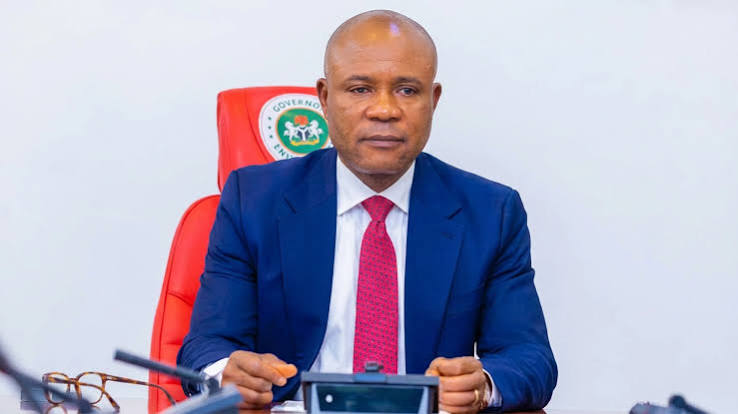
The largest single line in Enugu State’s 2026 Approved Budget sits inside the Governor’s Office. In the 868-page document, titled Budget of Renewed Momentum and examined by SecretsReporters, the Enugu New City Corporation carries a capital vote of N200,000,000,000 for 2026 under Governor Peter Mbah’s own office, and no project is named against that money anywhere in the budget.
The budget names roughly four thousand capital project lines across the government, ministry by ministry and project by project. Against the N200,000,000,000 voted to the New City Corporation, no project breakdown is published anywhere in the document, and the state’s second quarter Budget Implementation Report records that nothing had been spent against the vote by June 2026. Under the Fiscal Responsibility framework, public money is appropriated for stated purposes and reported against them; a vote of this size carrying no stated purpose defeats legislative oversight, because neither the House of Assembly nor the public can trace what the money is meant to buy. The corporation’s own record deepens the problem. In 2025 it spent N30,000,000 between January and September against an original capital vote of N15,000,000,000 in the budget book, cut to N5,000,000,000 on revision, while the state’s Citizens Accountability Report for 2025 tables an allocation figure of N97,141,700,000 for the same corporation, a figure that does not match the budget book’s N15,000,000,000.
The Governor’s Office as a whole carries a 2026 budget of N296,522,216,694, of which N16,423,790,215.90 was spent in the first half of the year. Inside the Office of the Executive Governor, the capital vote is N35,150,000,000, and its dedicated lines include N14,000,000,000 for the purchase of motor vehicles, N9,050,000,000 for the purchase of security equipment, N10,000,000,000 for the construction and provision of roads inside the Governor’s own office, and N505,000,000 for the purchase of health and medical equipment. By June 2026, N1,602,798,119.11 of that capital vote had been spent, a performance of 4.6 percent.
The running costs of the same office moved at a different speed. The Office of the Executive Governor carries an overhead vote of N34,131,200,000 for 2026, and N14,519,588,330.23 of it was spent in the first six months, 42.5 percent of the year’s provision. Inside that overhead sits a security vote of N7,200,000,000, a provision whose spending is published without any breakdown of what it bought. The budget book’s own comparative columns show that N300,000,000 was spent against the identical N7,200,000,000 vote in the first nine months of 2025, and N2,500,000 in 2024. Beside it stand security services at N4,360,000,000, donations at N3,000,000,000, publicity and advertisements at N2,300,000,000, welfare packages at N1,650,000,000, and refreshment and meals at N1,400,000,000. The office’s personnel vote carries a single line of N3,000,000,000 described only as Arrears Allowances, appearing for 2026 alone with nothing against it in the 2027 and 2028 out-years, and no explanation anywhere in the document of whose arrears they are or what period they cover.
Travel and transport inside the office is voted at N3,550,000,000 for 2026, made up of N2,000,000,000 for local travel others, N750,000,000 for hotel accommodation, N650,000,000 for international travel others, N100,000,000 for international travel training and N50,000,000 for local travel training. Medical expenses carry N40,000,000 for local and N30,000,000 for international. The pattern inside the Governor’s Office matches the fastest-spending lines across the state: by June 2026, welfare packages statewide had reached 63.4 percent of their year’s vote, honorarium and sitting allowance 61.8 percent and donations 49.2 percent, while the state’s capital programme of N1,296,092,465,000 stood at 9.1 percent. The revenue side of the Governor’s Office tells the same story in reverse. The office administers a revenue vote of N426,797,310,000 for 2026, and by June it had collected N6,277,637,300.89, a performance of 1.5 percent.
Enugu’s chart of accounts carries no separate Government House organisation, and Government House functions sit inside the Office of the Executive Governor. The one Government House line that appears in the records is an earnings line for the Government House Clinic, budgeted at N5,000,000 for 2026, against which N1,434,000 was collected in the first half of the year. No dedicated capital line for the clinic appears anywhere in the 2026 budget.