
 By
By By Elfredah Kevin-Alerechi
This story was supported by the Pulitzer Center.
Nigerian fishermen forecast the tide to determine when it would be high, and their forecasts have always been correct prior to the increasing influence of climate change and the high sea level rise. Sadly, the effects of climate change have altered their forecasts.
Early this year, 50-year-old Gladday Adolphus foresaw the sea level rise and set out to fish three hours away from his home in a boat with a paddle and a fishing net. He anticipates that the tide will still be high when he returns to his home, Fishermen estate in Marine Base, Southern Nigeria, to sell the fish. Unfortunately, the tide turned while he was out at sea, and the fish went bad before he could reach home and sell them (fish) to his customers, who majority are female fish traders.
Mr. Adolphus has lived at the Fishermen estate for thirty years, visiting several rivers in the Rivers State to capture a variety of fish. He was one of the first residents to move into the estate. Some of the residents of Fishermen’s estate depend on fishing to make a living.
Adolphus goes fishing, just like most fishers, day and night, scouring rivers for fish. Fish are always observed and captured in the river during the low tide period, according to him, but during the high tide “it is always tough to acquire fish.”
Adolphus claimed that because they can no longer compare the tide to their regular prediction, which has always been accurate, climate change has impacted their ability to predict the tide.
“There are times we predict that the river will not be high, but before we know it, the river will be high.
“By the time we follow our prediction and enter the river, the river will be high, and we won’t see any fish to catch,” Adolphus recalled other occasions when he had gone into the river to fish in the hopes that the tide would be low. Unfortunately, the tide got high, and he had to come home empty-handed.
He said that the high tide prediction had changed as a result of climate change, which had an impact on his income, particularly for his wife and children. He makes do with the money he received from the sale of his fish to support himself, and his wife, and to pay for the education of his four children.

Tamunoiduwaba Joshua, 50, was found behind his house, a collapsing zinc building, close to the river. In order to get ready for the evening catch, he was busy stitching his fishing net.
He had the same condition as his coworker Gladday. The dua go out to sea together as fishing partners and come in after their haul.
Mr. Joshua, who has been fishing for more than twenty years, acknowledged that the tide did not come in as foretold by their ancestors, who they typically follow.
There is no certain time to capture fish these days due to climate change, even though there won’t be any fish when the tide is high.
“Between today and tomorrow, the best time to catch the fish changes, and sometimes the fishes play for three days, and return.”
“We can say by May, we will have a big river (high tide) and by October and November too, but when it gets to the month, the river will not be high,” he told the reporter behind his residence while sewing his fishing net.
According to a 2019 study, rainfall in southern Nigeria is predicted to increase, and increasing sea levels are predicted to intensify flooding and the submergence of coastal regions. According to additional studies, Nigeria’s climate has been changing, and this includes temperature rises, erratic rainfall, a rise in sea level, and flooding.
A report by the World Meteorological Organization on the State of Climate in Africa, climate change is having a growing impact on the African continent, especially affecting the most vulnerable. It also contributes to food insecurity, population displacement, and stress on water resources, and it increases the risk of disease and other health problems.
The Food and Agricultural Organization (FAO) conducted research in 2020 that revealed fish capture had considerably declined over the past 20 years despite gradually rising average sea surface temperatures. For instance, the research says that between 1992 and 2016, the major catch of artisanal fishers of the climate-sensitive round sardinella fell by 75 percent. Thousands of artisanal fishers and women working in the seafood value chain are extremely exposed to the effects of climate change in both countries since they have few other options for a living.
Effects Of Sea Level Rise Still Being Felt
Artisanal fishermen in Nigeria, who provide the majority of the seafood consumed by the majority of the nation’s over 200 million citizens, have been severely impacted by the effects of sea level rise and changes in the pattern of rainfall.
According to four Nigerian fishermen (Steve Steve Hriaha, Dappa Otikor, Salise Jumbo, and Destiny Apana) who live in Cameroon close to IKANG (Esuk mkparawa), Bakassi river in Cross-Rivers State, in southern Nigeria, the sea at Ikang river typically experiences waves that are higher than usual at high tides. The quads are natives of Rivers State’s Andoni, but they have since moved to Cameroon.

When Nigeria lost the Bakassi Peninsular to the Republic of Cameroon at the International Court of Justice, certain residents in the bordering Cameroonian state of Bakassi were relocated from Cross River State (ICJ).
Ikang is a fishing village where the majority of people sell and catch fish. The bulk of its fishermen fish over Nigeria’s border with Cameroon due to the sea’s connection to that country.
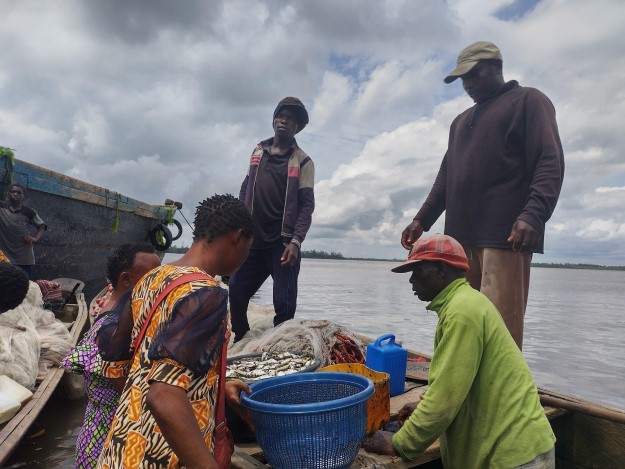
To sell their harvest to female fish traders, the fishermen often fish in the area of Andoni Bakassi, Combu dimo 4, all the way down to Ikang in Cross-Rivers State.

The reporter had to travel from Rivers State to Cross-River State to speak with the fisherman working in the sea near Cameroon to learn how the changing weather patterns and sea level rise may affect their catch.
They described how, in late May, two of their fishing co-workers went out to fish, but the tide was high to the point that the wind blew, amplifying the waves in the sea, which caused their fishing boat to capsize and result in their deaths.
“When the wind blows in this river, and when the waves come in, no one can cross this river, even those who know how to swim can’t cross the river with our boat.
“We will have to wait until the waves come down, but the two that died don’t even know how to swim and they went alone,” they simultaneously said.
According to reports, the Cross Rivers Sea has an estuary that is 24 km (15 mi) broad and has its outlet in the Atlantic Ocean.
Numerous studies have shown that ocean waves can be fatal and can injure the ankles, shoulders, neck, knees, and even enough to sprain them.

Twenty years of Steve Steve Hriaha’s life have been spent fishing. He has relied heavily on fishing in and near the Nigerian and Cameroon rivers to stay alive. He bemoaned the fact that “since the water is so large, we rarely see fish but now, we are lucky to capture fish.”
Mr Hriaha recalls, “During this rainy season, we don’t see fish in the river, and we usually suffer because there are no fish.”
The cost of fish depends on the quantity of catch we had, “and, if we catch a few fish, the cost will be higher than if we had caught a huge quantity of fish,” said Dappa Otikor.

Since there are rarely any fish to be caught in the river during the rainy season, which lasts from August to December, it has an impact on the price of sales, according to Mr. Otikor, who has more than 20 years of experience in the fishing industry.
“For example, the fish you see now is sold for N7,000 ($17) but if we had caught enough, we would have sold it for N4,500($11),” he said, as he points to the small basin of Ethmalosa Fimbriata fish locally called Songu by the Okrikans.
Statistics of Nigeria’s fish production
Africa’s most populated nation is Nigeria, which has more than 200 million residents. According to Worldfish, an international, non-profit research and innovation organization with the goal of decreasing hunger, malnutrition, and poverty across Africa, Asia, and the Pacific, fish makes up around 40 percent of the nation’s protein intake, and fish consumption is about 13.3 kg/person/per year.
The annual total for fish production is close to 1 million metric tons (313,231 metric tons from aquaculture and 759,828 metric tons from fisheries). Around 10 percent of this fish is exported, with the balance being consumed domestically.

In a press conference, Nigeria’s Minister of Agriculture and Rural Development, Alhaji Sabo Nanono, stated that the country produces about 1.123 million metric tons of fish annually, compared to 3.6 million metric tons of consumption. However, despite importing fish, Nigeria’s total fish production still does not meet the nation’s demand for fish.
Impact Of Dwindling Fish Catch On Women Fishing Traders
The majority of fish sellers are women who are most times vulnerable to the impact of climate change. The impact of Climate change in Nigeria is not new but the increasing impact on women fish traders is affecting households headed by women.
Nigerian men are mostly the fishers who travel across the shores and within the boundaries of the country to catch the fish and sell it to women traders, who then take it to the market to sell to consumers.
Climate change has caused depletion of fish in the sea, which affects the cost price, thereby making it difficult for the women fish traders to sell to the consumers.
Women make up the majority of seafood vendors, and they are frequently more at risk from the effects of climate change. The effects of climate change in Nigeria are not new, but they are
becoming more pronounced for women who trade in fish, which has an impact on homes run by women.
Most fishermen in Nigeria are males who travel across the country’s borders and within its borders to capture fish and sell it to women traders who then sell it to customers on the open market.
Due to the decrease in fish populations brought on by climate change, women fish sellers find it challenging to market their products to clients due to rising costs
Because of the decrease in fish populations brought on by climate change, women fish sellers find it challenging to sell to consumers due to rising costs.

Cross River State’s Ikang Esuk Mkparawa market is where Maria Nsikak Edem sells fresh fish. She is one of the ladies who runs a home and relies on the income from the selling of her fish to support the upbringing of her eight children.
According to Mrs. Edem, whenever she purchases fish from the fishermen at a high price, the majority of her clients complain about the price being too high and occasionally stop doing business with her.
She said, “some of my customers will buy the fish, while some will leave the fish, saying it is expensive and in the end, the fish will spoil.
“When they spoil, I will throw the fishes away,” what will I use rotten fish for? she asked.
Edem has been in the fishing industry for 16 years, and when business is slow, she finds it challenging to pay the tuition for her kids.
“I pay my children school fees, house rent, feeding, and daily shop rent (where she sits and sells the fish) all are paid from the profit made from the sales of fish.
” Last week (Early June) I bought fresh fish for fifteen thousand naira ($37), but I only sold $5 worth of fish and I managed to dry some, but the amount I used to buy the fish was not even recovered, ” she recalls.
In contrast to Edem, whose customers in Cross Rivers State typically opt not to buy fish if costs are high, Gift N, 30, is the opposite.

Despite the complaints of Gift’s customers regarding the excessive price of the fish, some eventually made purchases from her. She claims that even when consumers choose not to purchase, none of her fish has ever gone bad. She used ice cubes to keep them safe.
At the creek road market in Southern Nigeria, Gift offers a variety of large fish. She has spent her entire life working at the market selling fish, having inherited the company from her late mother.
Gift stated, “I would have to fly to Calabar to get fish because the men that go to the sea say there are no fish in the river. I generally buy the fish at a premium price, sometimes even with my money
Calabar, the capital of Cross Rivers State, is around 232.9 kilometers away from Rivers State without traffic congestion.
“When we buy high, the prices will not be the same it was previously sold for, and our customer will complain but later buy it, “she said.
“If one customer didn’t buy it because of the price, another will come to buy it,” the difference is that we’ll have to spend a longer time than when it is cheap.

Another fish trader who is feeling the effects of climate change is Silver Etu. She and her seven children have survived solely on the profits from her fish business.
Ms. Etu said that she was not distinct from other fish sellers in the state of Cross River. She finds it challenging to purchase most of the time because the cost of seafood has soared.
“When we buy at a high price, our customers complain, and it will be difficult for us to sell,” she said, adding that, “the remaining (fish) will be put on an ice block, and something they will spoil it will affect me and my family.
Her only request is that the government assist her and other female fishermen to support their businesses.
Another trader, Iquo Ekeng, and her six children reside in the Esirun village in the state of Cross River. Every time she purchases fish at a premium, “my customers will refuse to buy, and I will use ice block to preserve it, but we will not make as much money as when the fish is still fresh from the river,” she says.

At the Epe market in Lagos, Bosede Lasisi, 70, has been selling fresh fish for more than 40 years.
Prior to the effects of climate change, Mrs. Lasisi made a sizable profit from her sales, and both she and the consumers could afford the fish. Sadly, as a result of climate change, which has made it harder for fishermen to catch enough fish, prices in Lagos have now gone up.
Because of the variety and low prices of the fish at Epe Fishing Market, some Lagosians shop there for fresh fish.
Lasisi said in her native dialect, “before, I buy a traypan of fish for N500, $0.8 but now it is sold for $13.”
She purchases her fish from local fishermen who dock near the market, but she claims that the increased cost of fishing gear and the intense waves that disrupt the fishermen are to blame for the increase in fish costs.

In order to purchase fish from fishermen and transport them to the Epe market, Agnes Folosho visits the fishing pot as well. She stayed at the fishing spot for the majority of the night before returning around midnight to sell the fish at the Epe fish market. She stated that June and July have already been advantageous to her and other fresh fish vendors since fishermen often catch enough fish and the price would be low, but the price of fish will increase after the season.
Women fish dealers in the Epe market keep the fresh fish alive and in its original condition on the riverbank next to the fish market until clients arrive to buy it.

Tomiwa Kalijaye, 40, uses baskets to store her fish beside the riverbank. Her parents, who were already in the fishing industry when she was born, taught her the trade.
Mrs. Kalijaye kept part of her fish in a basket known as an “aggo” in her community, but she faced a problem during the fishing season when there wasn’t enough fish to go around. She said that they benefit from the rainy season because they have an abundance of fish, whereas, during the dry season, fish are harder to come by.
“When the river is dry or the water is hot, the live fish we keep in the basket that has been kept alive in the basket will die,” she said, adding that this has been the challenge of women fish traders in the Epe market.
They sell the river fish alive, but when they are dead, the price will drop, resulting in loss and making it often impossible to recover their investment.
Nene Jamabo, the chairperson of the Nigerian Fishery Association’s Rivers State branch, said the effects of climate change have resulted in heavy sea currents, which have forced fish to migrate to rivers in search of food and a convenient location to lay their eggs.
The fishery specialist claims that the paucity of fish in the river is a result of the impact of climate change on the distribution of fish species during a particular season
According to Jamabo, as fish migrate to new regions, it becomes more challenging for fishermen to capture fish, and large rainstorms have an impact on fishermen and their fishing boats.
“You will find out that when the fishers go fishing, there are some species of fish they are supposed to get this period, but they are not getting it because of the effect of climate change.
“The fish move from one environment to another, in search of food, migrate for production, they need better ground where they can go and lay their eggs to be safe,” Jamabo said.
Call for Government support
Nearly all the female fish traders and fishermen who had voiced complaints about the effects of climate change pleaded with the Nigerian government to help them continue their businesses in spite of the significant effects of climate change on their catch and sales.
According to Jamabo, the Nigerian government can help lessen the effects of climate change on fisheries and fish traders. She admitted that the strong river current is too strong for the local fishermen’s fishing boats to withstand.
“The waves’ action affects the fishers when they are on the high sea, and heavy waves break the fishers’ boat and can also kill them,” Jamabo said.
She urged the government to empower the fishermen by providing them with better tools, stronger fishing equipment, and soft loans to help them purchase boats that can be used to fish on the high seas, such as trawler vessels that can withstand strong currents.
“The government can bring the fishers together to form a cooperative and give them boats to assist them and it will go a long way for them,” she suggested.
Additional reporting by Kevin Woke.