 By
Titilayo Folorunso is serving seven years in prison on each count of trafficking, procurement for prostitution and organising foreign travel to promote prostitution. On 8 May 2026, Nigeria’s Supreme Court, in a unanimous judgment, threw out her final appeal. Investigators of the National Agency for the Prohibition of Trafficking in Persons found that she lured her victim with the promise of a teaching job in Malta and moved her through the Niger Republic into Libya. The conviction was secured under the Trafficking in Persons (Prohibition) Enforcement and Administration Act 2015, and it stands as one of Nigeria’s biggest anti-trafficking wins of 2026.
It also exposes a crack at the heart of West Africa’s regional response. The transit state at the centre of her case, Niger, no longer sits inside the anti-trafficking architecture that is supposed to coordinate the fight against her kind. On 29 January 2025, Burkina Faso, Mali and Niger formally left the Economic Community of West African States, a year after their juntas notified the bloc in January 2024 under Article 91 of the revised ECOWAS Treaty. ECOWAS’s own press statement that day said the withdrawal had become effective, with transitional arrangements for passports, trade and visa-free movement kept in place “until further notice”. Nothing equivalent was announced for trafficking in persons. The split has already rewritten the region’s commerce, as SecretsReporters showed in its computation of Nigeria’s 2025 exports to the three departed states.
Seven months later, the gap was on public display in Lagos. From 1 to 5 September 2025, the ECOWAS Commission, through its Directorate of Humanitarian and Social Affairs, convened the 17th Annual Review Meeting of the Regional Network of National Focal Institutions Against Trafficking in Persons Plus, known as RNNI-TIP+, in Lagos, Nigeria. The review, guided by the Annual Synthesis Report for 2024 implementation, drew representatives from 12 ECOWAS Member States, the focal institutions responsible for combating trafficking, sexual and gender-based violence and violence against children. International partners including the International Labour Organization, the United Nations Office on Drugs and Crime, the United Nations Population Fund, the International Organization for Migration, UNICEF, UN Women, the International Committee of the Red Cross and Plan International took part.
What the roll call did not show was just as important as what it did. The three countries of the Alliance of Sahel States, Burkina Faso, Mali and Niger, were not in the room, not as members and not, on the public record, as guests. The meeting was chaired by Dehunge Shiaka of Sierra Leone, the Executive Director of Sierra Leone’s Anti-Trafficking in Persons Agency, who told the closing session that migration remained one of the main drivers of trafficking in the region and that some countries had been identified as key transit routes. He urged governments to warn citizens that dangerous journeys could trap them in trafficking networks in both transit and destination countries.
The architecture under review is not a small one. The ECOWAS Plan of Action Against Trafficking of Persons, originally covering 2018 to 2022, was extended by member-state experts to run to 2028, and at the same 2023 meeting the Regional Referral Mechanism was validated as the tool for seamless cross-border referral of victims and coordination of prosecutions. A referral mechanism is built to carry victims and case files across borders. It cannot work across borders whose states have left the network.
The geography it now misses is the heaviest trafficking geography in the region. The United States 2025 Trafficking in Persons Report found that Mali’s transitional government had passed a new penal code, adopted in December 2024, that increased penalties for trafficking and criminalised descent-based slavery, and on hereditary slavery alone it reported investigating 30 cases and prosecuting 234 defendants, up from eight cases and 24 defendants the year before. Niger’s effort moved the other way. The same report, which placed Niger on the Tier 2 Watch List, recorded fewer investigations and prosecutions than the year before: five cases investigated, prosecutions opened against 10 alleged traffickers, eight traffickers convicted under Article 270 of the penal code, and 17 victims identified and referred for care, down from 77. Niger’s draft national action plan, covering 2023 to 2026, had still not been finalised. Benin, by contrast, was upgraded to Tier 2 in 2025, with more traffickers prosecuted and convicted and a new national action plan developed.
Mali is not an abstract destination. In 2026, Nigeria’s House of Representatives, on a motion moved by Rep. Tolulope Akande-Sadipe, demanded a reintegration plan for trafficked Nigerians rescued from Mali, noting that victims were being returned to Nigeria without medical care, psychosocial support, education or vocational training, and warning that they remained vulnerable to re-trafficking. The House mandated its committees on humanitarian services, diaspora, foreign affairs and justice to investigate the situation of trafficked Nigerians in Mali and across West Africa. Niger, for its part, remains the corridor itself, the land bridge through which the Supreme Court in 2026 confirmed traffickers still move victims toward Libya, where a day earlier, on 7 May 2026, the Federal High Court in Lagos had separately convicted Bose Jimoh and handed her seven years in prison plus a fine of N4 million, also under the Trafficking in Persons (Prohibition) Enforcement and Administration Act 2015.
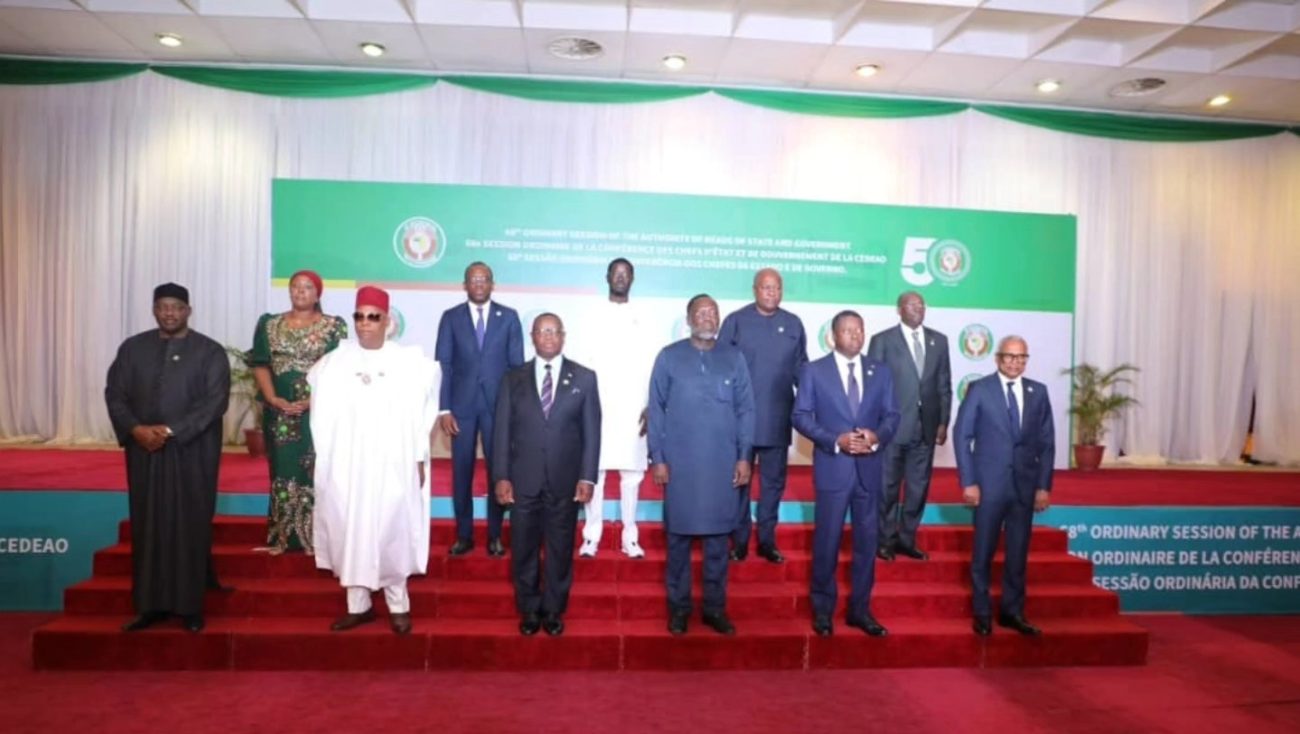
The contrast with another crime domain is sharp, and it is ECOWAS’s own making. At its 68th Ordinary Session in Abuja on 14 December 2025, chaired by Sierra Leone’s President Julius Maada Bio, the ECOWAS Authority granted the admission of Burkina Faso, Mali and Niger as non-ECOWAS members of the Inter-Governmental Action Group against Money Laundering in West Africa, GIABA, dependent on their commitment to implement anti-money laundering, counter-terrorism financing and counter-proliferation obligations. The decision, published by GIABA on 22 December 2025, followed a July 2025 recommendation by the GIABA Ministerial Committee in Accra. The GIABA establishment statute permits non-ECOWAS member states to join. At the same Abuja session, the Authority also endorsed the three states’ continued place in the ECOWAS Bank for Investment and Development as non-regional members. ECOWAS built post-withdrawal accommodations for dirty money and for its development bank. For trafficking in persons, SecretsReporters found no equivalent published instrument on the public record. It is the same habit of selective enforcement SecretsReporters documented in the 50 ECOWAS Court judgments Nigeria itself has left unpaid.
Bilateral diplomacy is filling some of the space, but its paper trail is thin. On 14 July 2026, Nigeria and Mali agreed to hold a Joint Commission to revitalise their dormant bilateral agreements, with security, trade, energy, irregular migration, human trafficking and the Bilateral Air Services Agreement named as priority areas for cooperation. The agreement came out of a courtesy visit at Tafawa Balewa House in Abuja between Nigeria’s Minister of State for Foreign Affairs, Ambassador Bianca Odumegwu-Ojukwu, and Mali’s Ambassador to Nigeria, Oumar Coulibaly. No Joint Commission session has been held, no communiqué was signed, and the ministry’s account of the meeting reached the public through a spokesman’s statement. In September 2026, on the sidelines of the 81st United Nations General Assembly in New York, Odumegwu-Ojukwu met Mali’s Foreign Affairs Minister, Abdoulaye Diop, and the two ministers discussed the evolving relationship between Mali and ECOWAS, the dynamics of the Alliance of Sahel States, and the cross-border nature of trafficking alongside terrorism, organised crime, arms proliferation and illicit financial flows.
The newest opening has not closed the gap either. On 17 October 2026 in Dakar, ECOWAS and the Alliance of Sahel States held their first formal ministerial dialogue and agreed joint thematic working groups toward a framework cooperation agreement covering 18 priority areas, among them free movement, trade, cross-border security, infrastructure and humanitarian assistance. Trafficking in persons is not named in any public account of those areas. No agreement has been signed, and no instrument extends the anti-trafficking network to the three states. At that same session, Nigeria said it was reviving its dormant bilateral Joint Commissions with Niger, Mali and Burkina Faso, the same commissions that have yet to meet.
What remains unknown, and what should be public, is the state of the system itself. The 17th Annual Review Meeting’s assessment of 2024 implementation was guided by the Annual Synthesis Report, a stocktaking tool for measurement, advocacy and targeted technical support. That report has not been published for public scrutiny. NAPTIP’s own records on how many 2024 and 2025 trafficking prosecutions involved transit through Niger or destination in Mali have not been disclosed. What NAPTIP publishes is aggregate: the United States report counted 744 investigations, 71 prosecutions and 49 convictions for Nigeria in its reporting period, with no breakdown by route or destination.
The bottom line is a matter of arithmetic that no communiqué can hide. ECOWAS now fights trafficking as a 12-state system, guided by a Plan of Action extended to 2028 and a Regional Referral Mechanism validated to carry victims across borders. The three states sitting on the heaviest trafficking geography, Niger the transit corridor to Libya, Mali the destination where Nigerians keep being rescued, and Burkina Faso the land bridge between them, sit outside that system. ECOWAS found a way to keep them inside the fight against illicit finance. It has yet to show the world a way to keep them inside the fight for the trafficked.