Connect with us

Politics

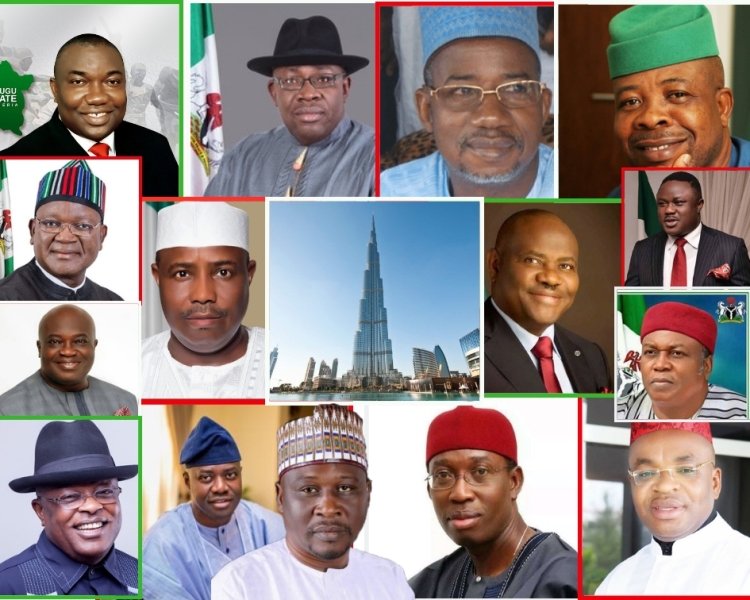
DUBAI GOVERNORS: AFTER KILLING RESORT CENTRES IN STATES, PDP GOVERNORS GOES TO DUBAI ON SPENDING SPREE

Published

on

Secret Reporters

Every government aims at ensuring that there is a steady increase in wealth and social economic development within its region viz a viz patronizing government or privately owned facilities and resort centres both for business and leisure purposes. However, with the lackadaisical approach of most governors over the years towards building and maintaining infrastructures especially health facilities, resort, etc, which has resulted in the dearth of existing infrastructures, they now opt for jetting out of the country whenever they are in need of these infrastructures.

This is evident in the planned Induction and Investment Retreat organized by the Peoples Democratic Party (PDP) governor`s forum scheduled to hold from 16th to 22nd of May 2019 at The Retreat Palm Dubai MGallery by Sofitel East Crescent and The Palm Jumeirah Dubai both in the United Arab Emirate (UAE).

The governors who may have perused through the existing resort centers within their states and the country and discovered that these centres, if they exist, are in a state of comatose due to poor funding with many presumably unusable as their facilities are not up to world-class standard resorted to the ‘City of Gold’ for the retreat all in a bid to cover their shame.

A critic who reacted to this planned spending spree by the governors in the guise of going for a retreat stated that “After killing our resort centres they are now running to Dubai for retreat, if those people killed their own will they be running there, What are they going there to do that cannot be done here? I think they are just using this as a cover up to go and spend our money while we are here suffering”.

It is not a fallacy that various centres and locations within the country which were renowned for their beauty and would have served as a perfect venue for the retreat has become a shadow of themselves due to negligence and poor funding by these governors and their counterparts.


Politics

Political Rascality: FCT Minister of State Mahmoud Media Aide Bin Usman Rano Appoints Six ‘Special Advisers’ and One PA To Run His Office

Published

on

Secrets Reporters

Political arrogance does not always arrive with noise. Sometimes, it comes dressed as a press statement, carrying official language, decorated titles and the quiet assumption that public office can be stretched beyond its lawful boundaries.

This was the case with a recent statement issued by Hon. Bin Usman Rano, media aide to Dr. Mariya Mahmoud Bunkure, the Honourable Minister of State for the Federal Capital Territory, announcing the appointment of seven persons to assist in running his office.

Rano, who is himself an aide, appointed Abubakar Alhassan Muhammad Lale as personal assistant. He also named Umar Bashir Umar as Special Adviser on Protocol; Abdullahi Muhammad Ghali as Special Adviser on Media; Bashir Ibrahim Sisay as Special Adviser on Student Matters; Najeeb Garba Lawan Rano as Special Adviser on Youth and Sports; Yusuf Tijjani YT Rano as Special Adviser on Special Duties; and Muhammad Uzairu as Special Adviser on Religious Affairs.

It was not the appointment of a personal assistant that raised issues. Public officers often work with assistants. The concern is the audacity of a ministerial aide appointing six “special advisers” to assist in running his own office, as though the office of a media aide had suddenly become a ministry inside a ministry, a caucus inside a caucus.

The statement did not cite any law. It did not cite approval from the president, the FCT minister, the minister of state, the Office of the Secretary to the Government of the Federation, the head of service or any recognised public service authority. It did not state whether the appointees would be paid from public funds. It did not say whether they would receive official identification, allowances, office space, protocol privileges or any benefit from the FCT Administration.

Instead, it simply announced them as “newly appointed officials” expected to strengthen the operational capacity of the office. That phrase alone should worry every Nigerian who still believes that public office must have boundaries.

Under Nigeria’s constitutional structure, the title “Special Adviser” is not a decorative label to be handed out for political convenience. It is a public-office designation tied to lawful authority, approval, remuneration and responsibility. Section 151 of the 1999 Constitution places the appointment of special advisers within the authority of the president, with their number and remuneration subject to lawful prescription.

Public office is not a personal estate. It is not a reward centre for loyalists. It is not a place where every aide creates his own aides, and those aides carry titles that suggest government authority.

At a time Nigerians are being told to endure economic hardship, reduce waste and accept the high cost of governance as unavoidable, a ministerial aide cannot casually announce six special advisers and expect the public to remain silent.

Continue Reading

General News

Ekiti Decide 2026: Inside the Election, Vote Buying, BVAS Lapses and Voter Register Discrepancies Cast Shadow Over APC Landslide

Published

on

Secrets Reporters

The overwhelming victory recorded by the All Progressives Congress (APC) in Saturday’s Ekiti State governorship election is coming under increased scrutiny as emerging evidence points to widespread vote buying, voter inducement, BVAS irregularities, and discrepancies in voter turnout calculations that have cast a shadow over the credibility of the landslide win.

While election authorities praised the poll for improved logistics, early deployment of personnel, and the peaceful conduct of voting across much of the state, investigations reveal that beneath the orderly process were significant integrity concerns that may have influenced voter behavior and public confidence in the outcome.

According to SecretsReporters findings, vote-buying operations were widespread across several local government areas, with political agents allegedly distributing cash and other inducements to voters in exchange for electoral support. Field operatives reported witnessing coordinated efforts around polling centres where voters were allegedly monitored and rewarded after casting their ballots. The scale of the inducement activities has raised concerns that financial influence, rather than genuine voter preference, may have played a decisive role in shaping the APC’s commanding victory.

SecretsReporters findings also reveal that concerns over ballot secrecy further complicated the integrity of the election. In several polling units, overcrowding and poor crowd control reportedly made it possible for individuals to observe how voters marked their ballot papers. In some locations, voters were allegedly required to display their marked ballots to party operatives before receiving promised payments, reinforcing fears that the election environment may have enabled coercion and compromised the principle of secret voting.

The credibility of the process was also challenged by accreditation anomalies. Reports from the field indicated that some individuals presenting printed voter details were accredited and allowed to vote without physical Permanent Voter Cards (PVCs), while other eligible voters were denied accreditation after the BVAS failed to authenticate their fingerprints or facial biometrics. Technical glitches involving the BVAS were also reported in several polling units before corrective measures were taken.

Adding to the controversy are questions surrounding the voter turnout figures announced after the election. Investigations revealed discrepancies between the voter register used for turnout calculations and the updated register for the 2026 governorship election. The inconsistency has fueled concerns about transparency and accuracy in the management and communication of election data.

Although the official results fell within the expected statistical range of polling-unit returns, suggesting that the final figures may not have been manipulated during collation, election observers argue that the integrity of the process extends beyond result tabulation. The widespread reports of vote buying, voter inducement, accreditation irregularities, and voter data inconsistencies raise fundamental questions about whether the APC’s landslide victory reflected the unfettered will of the electorate.

With attention already turning to the 2027 General Election, the Ekiti governorship poll is likely to reignite national debate over the growing influence of money politics, weaknesses in electoral safeguards, and the urgent need for stronger enforcement against electoral offences.

For many observers, the central question emerging from Ekiti is no longer whether the votes were counted correctly, but whether voters were truly free to make their choices without inducement, pressure, or systemic irregularities.

Continue Reading

General News

Vote Buying Scandal Erupts in Ekiti Election Despite Improved Logistics and Early Voting Turnout

Published

on

‎Secrets Reporters

Allegations of widespread vote buying have significantly overshadowed what observers describe as improved election logistics during the ongoing Ekiti State governorship election, raising fresh concerns about the credibility of the process.

‎Investigative field observations from multiple monitoring sources indicate that while the Independent National Electoral Commission (INEC) recorded notable progress in the timely deployment of materials and early commencement of voting across most polling units, the election day has been heavily tainted by reports of financial inducement of voters in several locations.

‎According to findings by SecretReporters, the election witnessed multiple instances of alleged vote buying across different polling units, where voters were reportedly offered cash and other incentives before and during the voting process. The report noted that these practices appeared to be more visible in areas with high voter concentration, raising concerns about the integrity of voter choice.

‎SecretReporters
further observed that despite improved logistics and faster polling unit openings compared to previous elections, the scale of alleged vote trading significantly undermined the credibility gains recorded in election administration.

‎The findings also suggested that enforcement against electoral malpractice appeared weak in several locations where such incidents were reported.

‎Despite these allegations, observers noted that election logistics represented a clear improvement compared to previous cycles, with a significantly higher percentage of polling units opening early and voting commencing on schedule in most locations.

‎However, the contrast between improved operational efficiency and persistent electoral malpractice has raised questions about enforcement and deterrence mechanisms on election day, particularly in hotspot areas where tensions and isolated violence were also reported.

‎Security presence was deployed across several local government areas, including Ikole, Oye, and Ilejemeje, where sporadic disruptions were recorded, although the general atmosphere was described as largely peaceful.

‎Attention has also focused on INEC’s use of the Bimodal Voter Accreditation System (BVAS) and electronic result transmission tools designed to improve transparency and reduce manipulation during collation.

‎While these reforms are widely seen as steps forward in electoral management, stakeholders caution that systemic issues such as vote buying continue to undermine gains made in logistics and technology deployment.

‎As collation continues, concerns remain that the integrity of the final outcome may be shaped as much by electoral conduct on the ground as by technological improvements introduced by the commission.

Continue Reading

Trending

Support Independent News