

Connect with us

General News

Recruited To Suffer: Nigerian Police Officers Left Behind As N1.31 Trillion Budget Prioritizes Everything But Their Welfare!

Published

on

Secrets Reporters

In a coordinated nationwide protest that stretched across several states, retired police officers gathered under heavy rain in Abuja and other state capitals to demand an end to what they describe as years of neglect, poverty and injustice.

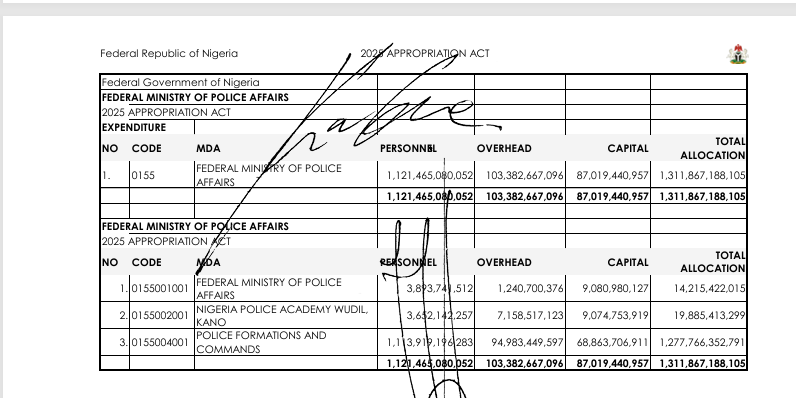
Meanwhile, an x-ray of the 2025 police budget reveals shocking priorities. While the total allocation stands at N1.31 trillion, only a negligible fraction is dedicated to the welfare of officers. The Ministry of Police Affairs earmarked a laughable N60.8 million for welfare packages, less than 0.005% of the entire budget. In contrast, billions were approved for armored vehicles, surveillance systems, and even pedestrian bridges at the Police Academy in Kano.
The recent demonstration of the retired officers over welfare, led by elderly former police personnel, took place at the gates of the National Assembly and state police headquarters in cities including Benin, Jos, Ilorin, Jalingo and Calabar. Many of the protesters, some visibly frail, held placards and chanted in defiance of the storm, standing their ground to demand a complete withdrawal of the Nigeria Police Force from the current Contributory Pension Scheme.

Their complaint is simple but piercing: after years of service to the nation, many of them retire to receive as little as N14,000 to N22,000 a month as pension. Several retirees described it as a system designed to impoverish rather than support those who had put their lives on the line for national security.

A retired Assistant Superintendent of Police, Joshua Abdul from Bauchi State, revealed he had gone without pension payments for nine months. He said some of his colleagues had died as a result. Another retiree disclosed that after serving for 15 years, he received a gratuity of just N3.6 million, a sharp contrast to what is received by counterparts in other security agencies who collect up to N30 million.

Chief Superintendent of Police Manir Lawal, who retired at age 67, was among those who addressed the crowd. He described the pension scheme as both exploitative and unjust. “We have served this country faithfully. We deserve to retire in dignity. This scheme has impoverished us,” he said.

The protests, which came just days after the Nigeria Police Force issued a statement urging calm and pledging commitment to reform, reveal a growing gulf between assurances from leadership and the lived experiences of retired personnel.

Inspector-General of Police Kayode Egbetokun, in a statement released through the Force Public Relations Officer, acknowledged the concerns and noted that the agitation for removal from the Contributory Pension Scheme has been ongoing since 2014. He said past and present police leadership have engaged stakeholders but are constrained by legal and fiscal complexities. According to him, exiting the scheme is beyond the authority of the police and lies with the National Assembly and other statutory institutions.

He added that the current leadership is exploring alternative solutions, including the use of internally generated revenue to support retired officers and engaging the private sector for additional pension support. But protesters see this as bureaucratic stalling. For many, nothing short of total exemption from the scheme would be acceptable.

The outcry from the streets stands in stark contrast to the 2025 budget of the Nigeria Police Force, which stands at over N1.3 trillion. Among the capital expenditures are figures that have raised eyebrows. These include N5 billion for armoured Toyota Hilux vehicles fitted with gun points, N4.6 billion for Safe School Intervention projects, N2.96 billion for surveillance systems, and N1 billion for pedestrian bridges at the Police Academy.

Despite a reported pension debt of N758 billion owed to security agencies as of June 2025, the budget made no provisions for its clearance. This has only fueled suspicions among retirees that their welfare is not a priority.

Security experts have warned that such neglect carries national security implications. Dr Kabiru Adamu, a respected analyst, noted that morale in the police force, active or retired, is tied directly to performance. “A demoralized police force jeopardizes security. If officers know retirement means poverty, corruption becomes attractive,” he said.

The protest in Abuja drew the attention of activist and politician Omoyele Sowore, who joined the demonstrators and criticized the government’s spending priorities. “How can a country allocate billions to buy trucks and ignore the men and women who once manned them?” he asked.

While the Inspector-General has directed police commands to protect the rights of the protesters and ensure the protests remain peaceful, the issue appears far from resolved. The National Assembly has yet to issue a formal response, even as retired officers vow to continue their campaign.

The figures tell their own story. The 2025 police budget shows a total allocation of N1.31 trillion. Of this, 85.5 percent goes to personnel costs, 7.9 percent to overhead, and 6.6 percent to capital projects. Less than one hundredth of one percent goes to welfare.

Continue Reading
Click to comment

Leave a Reply

Your email address will not be published. Required fields are marked *

General News

Army Builds Schools, Town Halls as Questions Grow Over Nigeria’s Deepening Security Crisis

Published

on

Secrets Reporters

As Nigeria continues to battle kidnappings, banditry, insurgency and violent attacks across several states, the Nigerian Army has shifted part of its public engagement toward community development, unveiling schools, town halls, boreholes and other infrastructure under its Civil-Military Cooperation (CIMIC) programme.


The Army says it has now completed more than 250 intervention projects nationwide, including schools, hospitals, roads, ICT centres, solar-powered facilities and water projects. The announcement came during the 163rd Nigerian Army Day Celebration (NADCEL 2026) in Rivers State, where Chief of Army Staff, Lieutenant General Waidi Shaibu, commissioned four new projects across the state’s three senatorial districts.


According to SecretsReporters‘ analysis, the Army’s expanding role in providing public infrastructure reflects a significant evolution in its relationship with civilians. While such interventions may improve public goodwill, they also expose a difficult reality: many communities are celebrating projects that ordinarily fall within the constitutional responsibilities of local, state and federal government institutions.


SecretsReporters further observes that although schools, boreholes and community halls can improve the lives of residents, they cannot replace the primary expectation Nigerians have of the military protecting lives, securing communities and restoring confidence in areas where criminal violence has become routine. Across many parts of the country, citizens continue to measure security agencies not by the number of projects commissioned but by whether they can travel safely, farm without fear and sleep without the threat of attacks.


The four projects commissioned in Rivers include the renovation of Community Secondary School, Obio/Akpor, Community Secondary School in Lueku, Khana Local Government Area, the reconstruction of a Community Town Hall in Oyigbo Local Government Area and the installation of a solar-powered borehole in Degema Local Government Area.


Speaking during the commissioning, Lieutenant General Shaibu said the projects demonstrate the Army’s commitment to complementing military operations with initiatives that directly improve the lives of citizens. He argued that lasting national security cannot be achieved through military action alone and described the Army’s Civil-Military Cooperation programme as a strategic platform for building confidence between soldiers and host communities.


The Army Chief disclosed that more than 250 intervention projects have now been completed across Nigeria, covering hospitals, classroom blocks, roads, ICT centers, solar lighting systems and water supply facilities. He urged benefiting communities to protect the projects and acknowledged President Bola Ahmed Tinubu for supporting the Army’s operational activities.
Earlier, the Chief of Civil-Military Affairs, Major General Musa Etsu-Ndagi, said the Rivers projects were deliberately distributed across the state’s three senatorial districts to ensure wider community impact.


Chairman of Obio/Akpor Local Government Area, Honourable Gift Worlu, welcomed the intervention, describing the renovated schools as a boost to education within the council.
For SecretsReporters, however, the larger issue extends beyond the ribbon-cutting ceremony. The growing visibility of military-led community projects raises broader questions about governance, institutional boundaries and public accountability. While civil-military cooperation is recognized globally as a tool for strengthening trust between armed forces and civilians, it is not designed to substitute for effective governance or diminish the military’s constitutional responsibility to defend the country.


The latest intervention also comes at a time when security remains one of Nigeria’s most pressing national concerns. In several parts of the country, communities continue to experience attacks by armed groups, while thousands of citizens have been displaced and economic activities disrupted by persistent insecurity.

Continue Reading

General News

Emem Usoro Scandal: Journalist Stanley Ugagbe Remanded in Kuje Prison Over Cybercrime Charges

Published

on

Secrets Reporters

Journalist Stanley Ugagbe has been remanded at the Kuje Correctional Centre by the Federal High Court in Abuja following his arraignment on a six-count charge filed by the Inspector-General of Police over publications concerning the Deputy Governor of the Central Bank of Nigeria (CBN), Emem Usoro.

Ugagbe was arraigned before Justice Salim Olasupo Ibrahim on Monday morning, where the charges were read to him. Following the proceedings, the court ordered that he be remanded in the Kuje Correctional Centre and adjourned the case until September 21st for trial.

The development marks the latest chapter in a case that has drawn attention from journalists and press freedom advocates nationally and internationally following Ugagbe’s arrest and detention by the Nigeria Police Force.

The charges stem from criminal proceedings instituted by the Inspector-General of Police before the Federal High Court in Abuja, accusing Ugagbe and Fejiro Oliver of conspiracy, cyberstalking and defamation arising from a series of reports titled “Exclusive: CBN Deputy Governor Emem Nnana Usoro Hides N1.4 Billion California Luxury Condo in Asset Declaration Scandal – Part 1”; “EXCLUSIVE: CBN Deputy Governor Emem Usoro Linked to N3.6bn Los Angeles Property Amid Questions Over Asset Declaration Compliance (Part 2)” published on SecretsReporters.

According to the charge sheet, the prosecution alleged that the defendants conspired to commit cyberstalking contrary to the Cybercrimes (Prohibition, Prevention, etc.) Act, 2015 (as amended in 2024). The police further accused Ugagbe of publishing stories alleging that the CBN deputy governor concealed a luxury property in California in her asset declaration, was linked to a multi-billion naira property in Los Angeles, and published another report concerning her personal life. The prosecution contended that the publications were false and constituted cyberstalking and defamation under the Cybercrimes Act and the Penal Code.

With the court now ordering his remand at the Kuje Correctional Centre, Ugagbe will remain in custody pending the next hearing, which has been fixed for September. The court is expected to consider issues relating to his bail and continue proceedings on the substantive charges at the adjourned date.

Recall that Ugagbe’s ordeal began on July 1, 2026, when armed men reportedly abducted him on his way home from work. The operatives confiscated his mobile phones and laptop before taking him away in an unmarked vehicle. For several days, neither his family nor his employer knew his whereabouts.

His disappearance sparked widespread condemnation from media organizations, including the Nigeria Union of Journalists (NUJ), which demanded that security agencies disclose his whereabouts, grant him access to his family and legal representatives, and either charge him before a competent court or release him.

International organizations also reacted. The Committee to Protect Journalists (CPJ) called on Nigerian authorities to investigate his disappearance and ensure his immediate safety, while the International Press Institute (IPI Nigeria) intervened in efforts that eventually led to his release from police custody.

Following his release on July 6, Ugagbe was granted bail while police reportedly continued investigating allegations, including espionage, cyberstalking, and other computer-related offences.

Continue Reading

General News

ICPC Probes News Agency of Nigeria Over Alleged Recruitment Irregularities After Secrets Reporters Expose

Published

on

SecretsReporters

The Independent Corrupt Practices and Other Related Offences Commission (ICPC) has commenced an investigation into alleged recruitment irregularities at the News Agency of Nigeria (NAN), seeking records relating to the agency’s employment and staff regularisation exercises conducted between 2024 and 2026.

The development comes days after SecretsReporters publication, titled “Alleged Sexual Harassment, Recruitment Controversy Rock News Agency of Nigeria as Female Employee Questions Grade Level Placement”.

The anti-corruption agency has formally requested a comprehensive range of recruitment and personnel records from NAN as part of an ongoing investigation into possible violations of the Corrupt Practices and Other Related Offences Act, 2000.

In a letter dated July 6, 2026, and addressed to the Managing Director/Chief Executive Officer of NAN, the ICPC directed the agency to produce the requested documents and designate a competent officer to appear before investigators at the Commission’s headquarters in Abuja.

The letter, signed by the Director of Operations on behalf of the Chairman of the ICPC, stated that the request was made pursuant to Section 38 of the Corrupt Practices and Other Related Offences Act, 2000, which empowers the Commission to obtain documents and information required for the purpose of investigations.

According to the letter, investigators requested all records relating to NAN’s recruitment and staff regularisation exercises between 2024 and 2026.

The Commission specifically requested recruitment advertisements, eligibility and selection criteria, lists of shortlisted applicants, names of successful candidates, and minutes of meetings of committees involved in the recruitment process.

The ICPC also requested the personnel file of Ogunola Folashade Adunni, together with any additional information that could assist investigators in determining whether due process was followed during the recruitment exercise.

Part of the letter reads: “This Commission is investigating an alleged violation of the Corrupt Practices and Other Related Offences Act, 2000 and it has become necessary to obtain certain documents/information from your office.”

It further directed NAN to ensure that a competent officer appeared before investigators with all relevant recruitment and personnel records requested by the Commission.

Continue Reading

Trending

Support Independent News