 By
By The Federal Government has unveiled a three-year Debt Management Strategy (DMS) in a bid to rejuvenate the economy and fund the N7.298 trillion budget. To be managed by the Debt Management Office (DMO), the strategy, according to experts, indicates that the country’s leadership is taking the right steps to exit recession and create jobs, writes COLLINS NWEZE.
All eyes are on the Federal Government to stimulate the economy by borrowing and the funding of critical infrastructure in this year’s budget through the Debt Management Office (DMO).
The N7.298 trillion budget is seen as a viable tool to fight recession, but a good part of it will come from borrowing.
The underlying assumptions for the 2017 budget, which become even of greater significance, at this time of recession, are average crude production of 2.2 mbpd; an average crude price of $42.5/pb and an average exchange rate of N305/$ (the current interbank rate). Then, a soaring oil price may compensate for an under performance on production, where that is the case.
But beyond the 2017 budget, the government says its economic team has returned to the drawing board to avert depression, and cushion the pains of the recession. Besides, countries caught in global, regional or national economic recession or depressions invariably, depend on borrowing to bail out their economies.
That Nigeria has developed a functional bond market, which it can take advantage of, remains a plus for the economy.
President Muhammadu Buhari has approved plans for external borrowing. The loans will be from the World Bank, the African Development Bank (AfDB), Japan International Cooperation Agency and Export-Import Bank of China. The DMO is to facilitate access to the funds from the multinational agencies.
To DMO Director-General, Dr. Abraham Nwankwo, a direct measure for reducing the high domestic debt service is to refinance maturing domestic debt with cheaper external debt instead of using domestic debt.
He hailed the Federal Executive Council’s approval of the DMS (2016 to 2019), saying the strategy would be implemented with a clear guide against unsustainable foreign exchange exposure.
For him, the country’s ability to borrow from a domestic debt market also has some strategic value. Besides, domestic debt reduces the exposure of the country to exchange rate risks and the limitations of the size of foreign reserves. The independence, he said, lies in the country having the option to exercise the choice to borrow from internal sources, external sources, or a mixture of both.
“Sovereign borrowing from the domestic debt market encourages the development of a functional bond market, with the scope to introduce different instruments, which will encourage the habit of domestic saving, intermediation and investment. Such a functional domestic bond market will be tapped by the private sector to raise long-term funds for investment in the real sector and infrastructure projects. Nigeria has developed a deep and liquid domestic bond market where funds of up to 20 years tenor can be raised,” he said.
Although there are concerns that Nigeria’s domestic debt has grown over the past decade while debt service outlay remains high, the domestic debt-Gross Domestic Product (GDP) ratio is only about 10 per cent; the total public debt-GDP ratio is 12.25 per cent. These compare favourably with the peer group threshold of 56 per cent.
Nwankwo said although the debt service-revenue ratio is high, the problem needed to be unbundled, while a decision is taken on the way forward.
“Following the rebasing of Nigeria’s GDP, the DMO observed that the increase in the GDP did not enhance the country’s ability to service its debts. Nigeria’s tax revenue-GDP ratio is still below six per cent compared to the average for the country’s peer group, which is 18 per cent. Already, the Federal Ministry of Finance and the Federal Inland Revenue Service (FIRS) are collaborating to improve tax collection and expanding the tax net so as to cut the debt service-revenue ratio,” he said.
Interestingly, Nwankwo assured that government was also tackling deficiencies in power supply, transportation infrastructure and information communication technology (ICT) infrastructure, guarantee high cost of production, which transmit into high cost of goods and services.
Besides, government is also promoting and increasing funding to agriculture and agricultural value-chains so as to bring down food prices and significantly dampen the overall inflation momentum.
“Post harvest preservation, for example through activation of the grain silos, is also being given priority. Beyond optimising on the existing revivable production capacity, the Federal Ministry of Agriculture and Rural Development, Federal Ministry of Water Resources and the Central Bank of Nigeria are collaborating effectively to stimulate more agro-businesses–cooperatives, clusters, as well as mega-scale investments,” he said.
Nwankwo said the country’s low debt to GDP ratio has cleared the road for the country to borrow more to fund its budget, infrastructure and other essential projects that will stimulate the economy and create jobs for the citizens.
Regarding foreign debt, the strategy is to borrow on non-concessionary terms for projects with self-paying capacity, and/or job creation potential, and on concessionary terms and grants for social sector projects.
The DMO chief explained that the focus of the new initiative is to develop a debt management strategy that would ensure that in the face of macro-economic and other financial constraints, the cost and risk profile of the public debt portfolio remains within acceptable limit over time.
The plan is also in line with President Buhari’s vision to generate maximum employment, reduce poverty and increase the living standard of Nigerians. Nwankwo further stated that for this to be effectively achieved, the government is making efforts in diversifying the economy against the backdrop of structural collapse in oil prices and oil revenue.
He said: “The Debt Management Strategy we are going to pursue over the next four years takes into account the fact that for now, Nigeria’s public debt portfolio is dominated by domestic debt. After the Paris and London Club exit between 2004 and 2006, the country took a deliberate decision to develop its domestic bond market and to do most of the public borrowing from domestic sources so as to develop the domestic bond market, that objective has been sufficiently achieved.
“And, therefore, taking into account that external financing sources are on the average cheaper than domestic sources, it becomes more necessary to slant more of the borrowing in favour of external sources. Therefore, one of the major elements of this strategy is that over the medium term, we will strive to remix the public debt portfolio from 84 per cent domestic and 16 per cent external to 60 per cent domestic and 40 per cent external.”
West African Institute for Financial and Economic Management (WAIFEM) Director-General, Prof. Akpan Ekpo, agreed with Dr. Nwankwo. He explained that budgetary allocations alone might be inadequate to finance the infrastructure deficit with dwindling oil revenue.
Prof. Ekpo described the debt option as the most viable, pointing out that Nigeria’s rebased GDP economy has given it the leeway to borrow more to bridge infrastructure gap.
To him, the DMO had in the past, demonstrated good negotiation skills in dealing with the country’s debt matters, either with internal or external creditors, adding that it would not be out of order for the government to borrow from the World Bank or the AfDB to fund the key developmental projects.
The government can also borrow internally to achieve the feat, he said, adding that internal borrowing is always short-term while external borrowing has longer tenor.
The DMO, Ekpo said, has the capacity and constitutional role to advise the government on the available choices. “The World Bank rates are cheaper with longer repayment term. The DMO can also leverage on the Nigeria Trust Fund with the AfDB to get a better deal on the loans needed to fund developmental projects,” he said.
Head of Macro-economic & Fixed Income Research, FBNQuest, Gregory Kronsten, said crude oil price will end the year on a low note. He said although the oil price has picked up from its recent floor in January and the budget assumption of $38/barrel, it has started to look conservative. The global supply/demand balance for crude is set to remain low until late next year, he added.
The thinking is that despite the marginal recovery in crude oil prices, borrowing is still needed because oil will remain low for a long time and may even crash below $40 in the face of production politics.
Currencies Analyst with Ecobank Nigeria Olakunle Ezun said although funds from the domestic bond market are more expensive than the international bond market, investing in the local bond market is also in the best interest of the economy.
Senate panel chair seeks debt management advocacy
A Senator has called for more advocacy to enable Nigerians understand why the government is planning to raise funds from the capital and bond markets.
Senate Committee on Local and Foreign Debts Chairman, Senator Shehu Sani, said if there was aggressive advocacy on what such loans would be for Nigerians would support such initiative aimed at driving development.
He spoke at a tretreat held for members of the committee by the Debt Management Office (DMO) in Minna, the Niger State capital.
According to him, it is imperative for the DMO to develop a framework in the major languages in the country to get the citizens to understand why debts are taken, for what purpose and what the society stands to benefit from such borrowing.
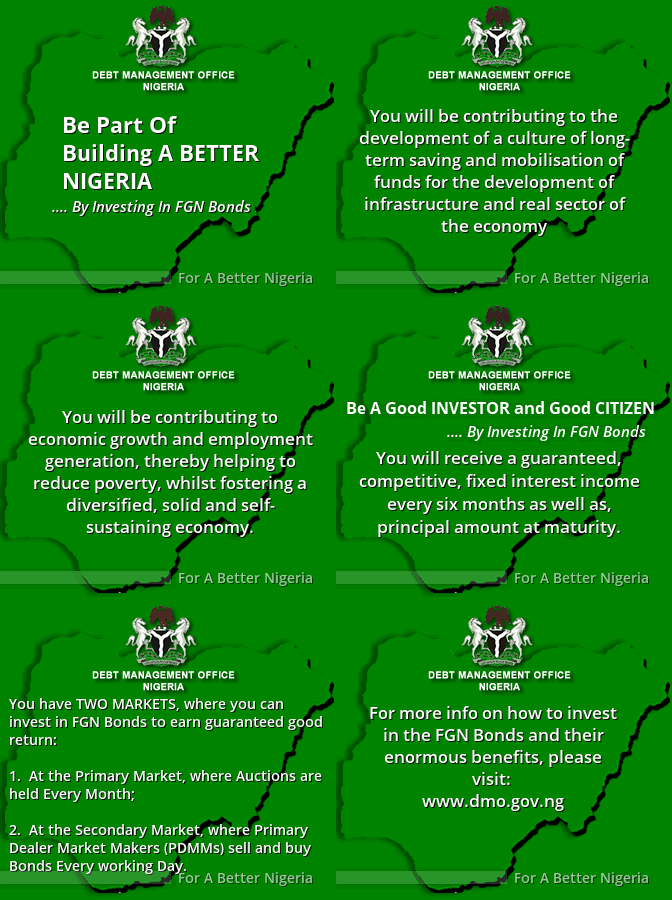
Overall, Nwankwo was upbeat that in the next few years, there will be significant improvement in employment generation, poverty reduction and living standard of the people, adding that as part of the new strategy, the DMO will develop new products, particularly the federal government saving bond and diversify the sources of raising funds domestically.