
 By
By Onoja Baba
The Independent National Electoral Commission (INEC) has come under fire for disbursing what adhoc staff describe as a peanut amount of N1,500 per day as transport fare, feeding, and training allowance during the February 21, 2026, Federal Capital Territory (FCT) Area Council elections.
This minimal daily rate left many of the temporary workers, including National Youth Service Corps (NYSC) members, financially strained and deeply dissatisfied after enduring intense physical and logistical demands to facilitate the polls across six area councils.
SecretsReporters has learned that only N10,500 was ultimately paid to corps members and other adhoc staff who served in the election. This total covered three days of rigorous training from 9 AM to 5 PM each day, plus election day responsibilities that included passing a night on bare floors, tables, and mats at collation or duty centers, followed by opening polling booths as early as 7:30 AM. Payments consisted of N6,000 in cash handed out on election day and N4,500 transferred to accounts four days later, with no further communication from INEC indicating if additional funds would be forthcoming.
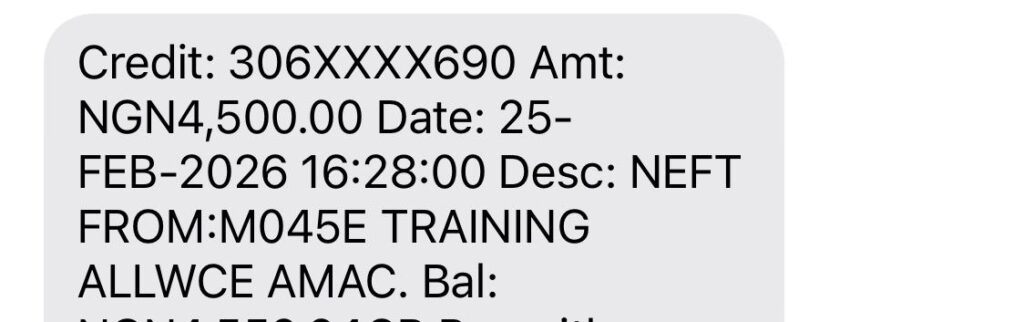
With no further communication from INEC regarding additional disbursements, many participants feel shortchanged and abandoned. One NYSC member, speaking anonymously to SecretsReporters, expressed profound regret over her involvement. “I regretted participating in the election as the stress does not worth it,” she said.
She detailed leaving her home around 2 PM the day before the election to report to the Registration Area Center (RAC), enduring a night on bare floors, tables, or mats, and then opening her polling booth by 7:30 AM on election day. Her ordeal ended only when she returned home around 10 PM that evening, exhausted and disillusioned.
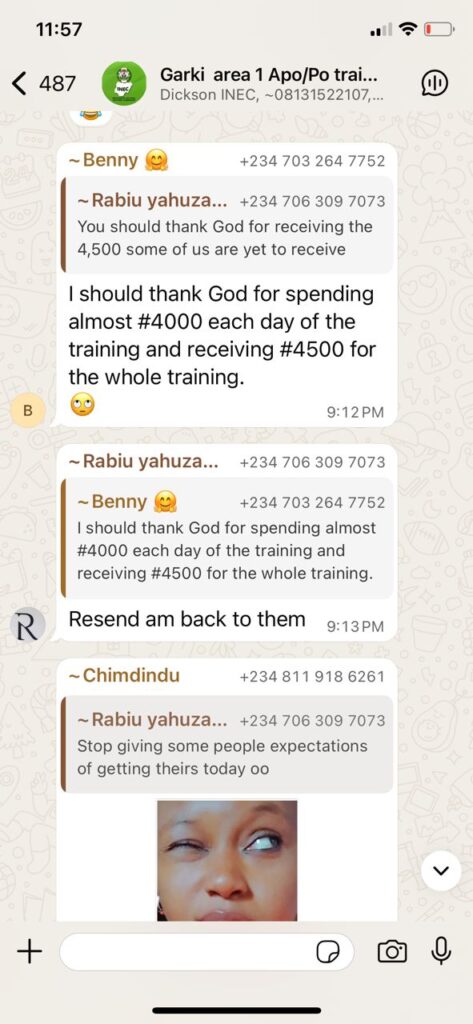
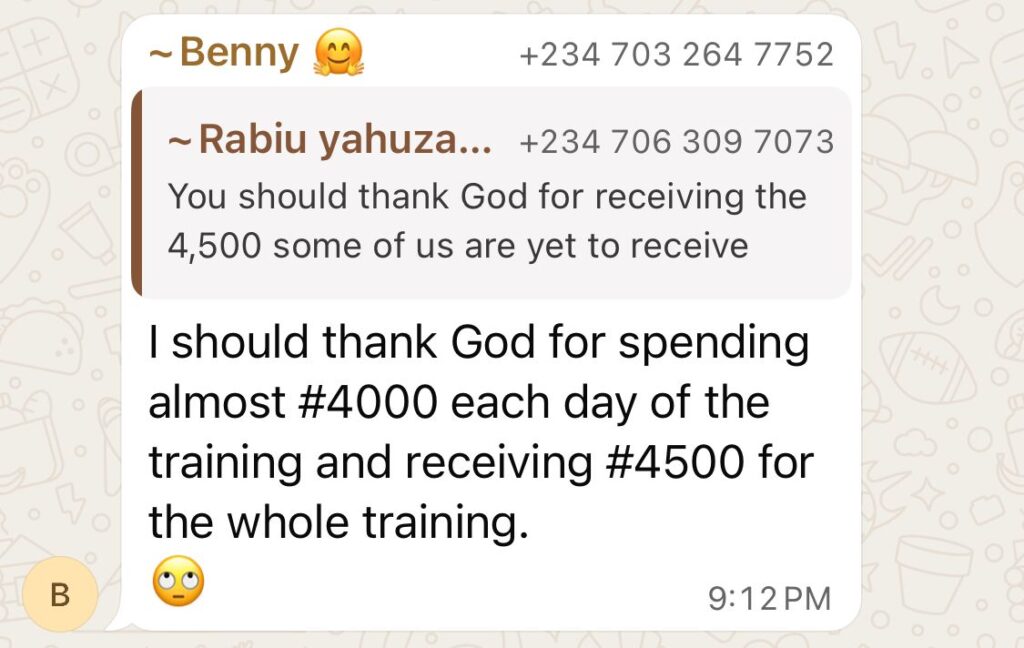
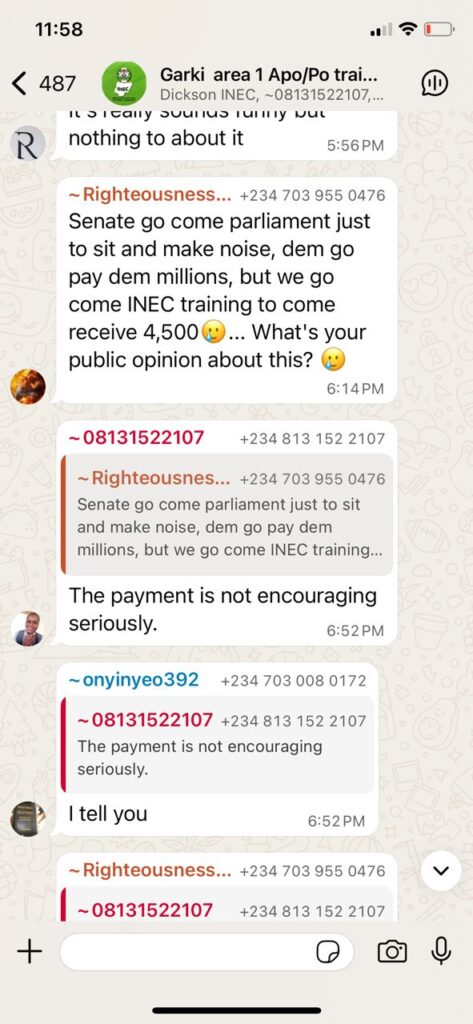
The training itself was no less demanding, spanning three days from 9 AM to 5 PM each session, where staff were drilled on electoral procedures under often uncomfortable conditions. Yet, the N4,500 allocated for this phase barely covered personal expenses, as highlighted by several participants. One adhoc worker, who was trained at the Area 1 Primary School AMAC, spending nearly N4,000 daily on transport alone to attend the sessions, only to receive a total of N4,500 for the entire training, effectively netting a loss, lamented in their WhatsApp group seen by SecretsReporters. “I should thank God for spending almost N4,000 each day of the training and receiving N4,500 for the whole training,” the worker stated sarcastically, underscoring the financial strain amid Nigeria’s rising living costs.
This discontent is amplified by queries from staff about outstanding payments. In group discussions among participants, one queried, “Are we still expecting Election Day payment from INEC? I thought the 6k cash that day was just feeding and transportation.” Such uncertainties persist without official clarification, fueling speculation that the N10,500 represents the full compensation.
Another participant compared the stress they faced to the job of the Nigerian Senate and the obvious disparity in compensation. He said, “Senate go come parliament just to sit and make noise, dem go pay dem millions, but we go come INEC training to come receive 4,500.” This comment highlights the perceived disparity where elected lawmakers receive substantial monthly salaries and allowances, often running into millions of naira, while adhoc staff, including youth corps members who endure grueling training and election duties, are compensated with a mere N4,500 for days of effort.
One of the adhoc staff highlighted the striking willingness of Nigerian youth to commit to demanding electoral duties without first inquiring about compensation, reflecting a deep sense of patriotism and hard work. As one participant put it, “Nah only for Nigeria I dey see where they youth start work finish without asking, Sir, how much are you paying me?… indeed, Nigeria youth are very hard working…we like work pass the money oh.” This sentiment underscores a pattern where dedication to national service often precedes any discussion of fair pay, with participants enduring rigorous training and long hours driven more by a sense of duty than by expectations of adequate reward.

This low compensation highlights a stark contrast with INEC’s substantial budgetary allocations for electoral activities. The commission proposed N171 billion for its 2026 operations, including the FCT Area Council polls, by-elections, and off-cycle governorship elections in states like Ekiti and Osun. The breakdown includes N109 billion for personnel costs, N18.7 billion for overheads, N42.63 billion for election-related activities, and N1.4 billion for capital expenditure. This funding supports routine and off-season polls under the newly enacted Electoral Act 2026, which introduces enhancements like electronic result transmission but does not yet reflect a pending NYSC request to raise corps members’ allowances to N125,000 per engagement, potentially adding about N32 billion if approved.
INEC’s larger projections underscore the disparity further. The commission has sought N873.78 billion specifically for the 2027 general elections, with components such as N379.75 billion for operational costs, N209.21 billion for technological upgrades including BVAS and IReV systems, N154.91 billion for capital expenditure, and N42.61 billion for miscellaneous expenses. Earlier proposals for adhoc staff in major elections have included higher figures like N50,000 election duty allowance per corps member plus feeding and training components, yet the FCT implementation fell far short, reinforcing perceptions of undervalued frontline workers.
The FCT polls, covering 68 elective positions across 62 wards, proceeded peacefully but with notably low voter turnout amid logistical hurdles. Adhoc staff played a pivotal role in setup, accreditation, voting, and collation despite challenges like material distribution delays and overnight accommodations. INEC has initiated probes into some operational shortfalls but has not publicly addressed the widespread grievances over allowances.
SecretsReporters contacted INEC for clarification on the adhoc staff payments, the rationale behind the N1,500 daily rate, and any plans for supplementary disbursements, but received no response by publication time.
As Nigeria prepares for more elections, including upcoming governorship polls and the 2027 general elections, these experiences raise critical questions about the sustainability of relying on adhoc personnel under such compensation structures.
Speaking on the situation, the Network Against Corruption and Trafficking, NACAT, told SecretsReporters that without meaningful reforms to ensure fair, timely, and adequate pay, the commission risks eroding morale among the essential workforce that upholds electoral integrity at the grassroots level.