Connect with us

STRAY BULLET

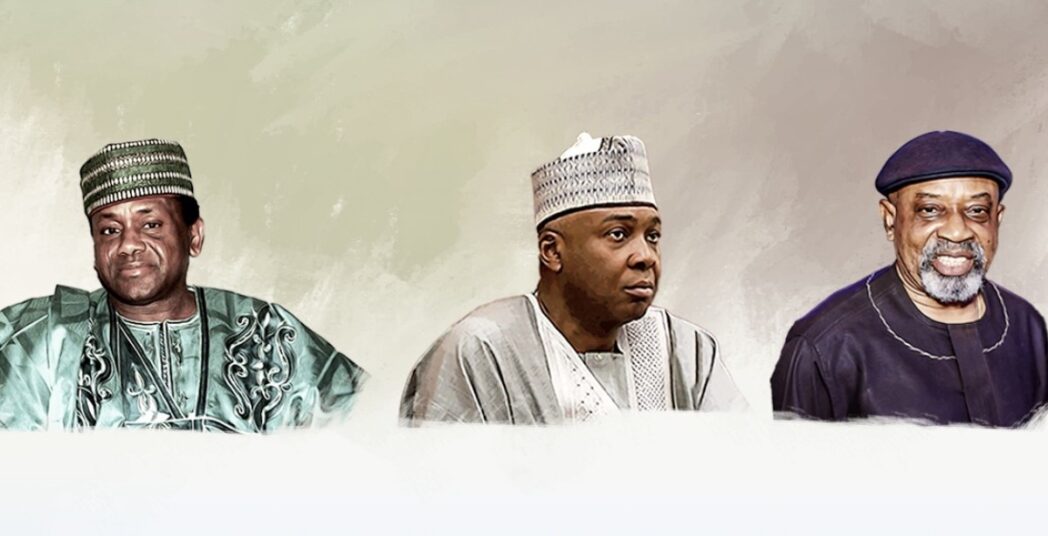
Abacha’s Loot, Saraki’s Hoot And Ngige’s Surprising Reboots

Published

on

Given the heart-wrenching human rights records and cases of extra-judicial killings recorded under him, it’s debatable whether the late General Sani Abacha would end up in theists’ heaven. Many Nigerians who are victims of Abacha’s reign of terror would probably think of him now dwelling on the “other” side of heaven.

But in the last few years, no one has acted as Nigeria’s supportive “father in heaven” as much as Abacha has done, principally in terms of providing succour for a cash-strapped nation at its most critical point of need.

This week, the National Crime Agency (NCA) of the United Kingdom announced the recovery of yet another $23.5 million in looted funds from the allies and family the late Sani Abacha. The funds were retrieved as part of a wider pool of funds identified by the United States Department of Justice (USDOJ) as having been stolen out of Nigeria in the 1990s by Mr Abacha and his accomplices.

Before 1999, Nigeria had been ruled by 11 leaders: eight military heads of states and three civilians. Of the eight military heads of state, three are dead while five are still alive. Since 1999, the nation has also been governed by four civilian presidents, three of whom are still alive—and one is dead.

Yet among all of these leaders, Sani Abacha, the late head of state, has had the most notorious mention in the media in the last few years. Almost every year, investigators across different jurisdictions across the world often discover huge amounts of money linked to Abacha and allies.  

“Relentless Giver”

Abacha ruled Nigeria between 1993 and 1998, when he died under mysterious circumstances. Since his death, every government that came after him has had to recover his loot from different jurisdictions. And word on the street is that he has been a “relentless giver.”

In an opinion piece published in a US publication in 2020, President Muhammadu Buhari made a tangential reference to recovery of the loot recorded under Abacha government, which he was a part of:

“And we can now move forward with road, rail and power station construction—in part, under own resources—thanks to close to a billion dollars of funds stolen from the people of Nigeria under a previous, undemocratic junta in the 1990s that have now been returned to our country from the U.S., U.K. and Switzerland.”

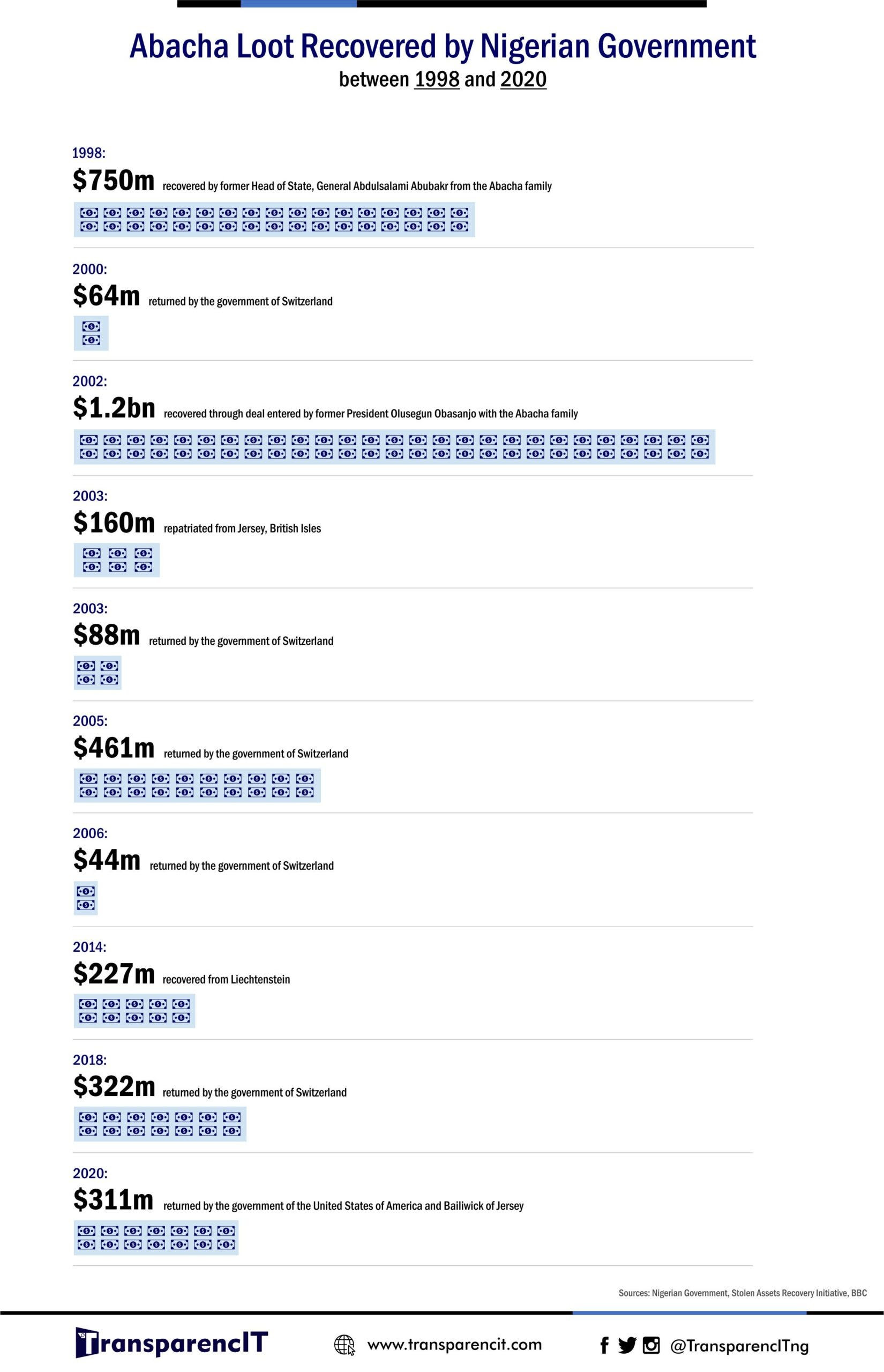
Meanwhile, a rough estimate of funds recovered from Abacha and allies since 1999, based on data crunched from newspaper reports, hovers around the region of $3.8 billion.

A TheCable report claimed that in 1998, Abubakar Abdulsalami, former military head of state, recovered $750 million from the Abacha family. In 2000, the report said, Obasanjo recovered $64 million from Switzerland; $1.2 billion in 2002; $88 million from Switzerland in 2003; and another $160 million from Jersey, British Island in 2003.

Between 2010 and 2022, the Jonathan and Buhari governments have equally recovered funds in the region of $1 billion.
Loot re-looted?

The plausible expectation of many is that the recoveries made from Abacha would help to shore up revenue shortfalls and bridge infrastructural gaps.

Last November, while speaking at a COP 26 high-level side event in Glasgow, President Muhammadu Buhari said the sum of $1.5 trillion is needed by Nigeria over a ten-year period, to achieve an appreciable level of the National Infrastructure Stock.

Yet since the Abacha loot recovery exercises have begun, the biggest fear remains that the loot may have been re-looted by government officials.

For instance, in 2020, part of measures put in place to ensure that a part of the loot isn’t re-looted was an agreement signed by the Federal Government, the government of Jersey and the United States to repatriate the latest $308m under certain stringent conditions. The agreement, signed by Attorney-General of the Federation and Minister of Justice, Mr. Abubakar Malami, detailed that the money be used to finance three major projects across Nigeria: Lagos-Ibadan Expressway (Western Region), Abuja-Kano Road (Northern Region), and Second Niger Bridge (Eastern Region).

The biggest fear lies principally in tranches of the loot being channeled toward programmes and policies designed to address the plight of poor and vulnerable Nigerians, which have been dogged with allegations of corruption and mismanagement.

Data sourced from the Africa Network for Environment and Economic Justice (ANEEJ) revealed that 703,506 poor and vulnerable Nigerians, out of an enrolled figure of 834, 948 targeted in the Nigerian social register, received a total of N23.742b from the recovered $322.5m Abacha loot returned from Switzerland as at December 31, 2019, under the Conditional Cash Transfer of the Social Investment Programme (SIP).  But the SIP had been under attack, especially for lack of transparency and accountability.

Earlier in 2019, a total sum of $103.64m Abacha loot the government claimed to have disbursed became the subject of controversies amid allegations of corruption, poor accountability and shoddy disbursement mechanism.

So as Nigeria receives yet another $23.5 million in looted funds from allies and family of the late Sani Abacha, the big question remains: how much of this money would yet again be re-looted?

Saraki’s Tu-whit tu-whoo

Since he emerged the “northern consensus candidate” of the People’s Democratic Party (PDP) alongside Bauchi State governor, Bala Mohammed, Senator Bukola Saraki has intensified efforts in his presidential campaign, proffering solution to a myriad of problems bedevilling Nigeria. Like an owl, he has been hooting wavering musical sounds into the ears of Nigerians.

Last week, Saraki promised free medical services to Nigerians if elected president, saying that he would leverage on his training as a medical doctor.

To be sure, Nigeria needs a total overhaul of its health infrastructure. In a first-of-its-kind Health System Sustainability index report released in March 2021, Nigeria ranked 14th with a total of 41 scores out of 18 African countries, with South Africa ranking first with 63 scores. Nigeria only improved slightly on the World Health Organisation’s (WHO) health system ranking from 187 out of 191 countries two decades ago to 163 out of 191 countries.

Yet in the midst of the poor records, concerns around funding remain fundamental. In 2019, the government said it would require a whooping sum of N1.08 trillion ($2.83 billion) to fix healthcare concerns alone.

The big question for Saraki remains: beyond picking up his long-abandoned stethoscope, how specifically does he intend to fund the deficit? Most importantly, in the context of Nigeria’s rural-urban inequalities and complexities, what constitutes “free healthcare”?

As the nation moves towards the 2023 polls, these are issues that must not be left muddled up in the typically Nigerian wild, wild field of bogus electioneering claims.

Ngige’s ‘System Reboot’

After claiming to have consulted with “mortal and immortals” ahead of the 2023 presidential election, the Minister of Labour and Employment, Senator Chris Ngige, finally announced his withdrawal from the race this week.

Since his withdrawal, many have opined that the minister was probably scared of the huge cost of electioneering. This could be a plausible reason, because Ngige had earlier lamented the huge cost of the APC nomination forms, saying his budget was N50m.

But a quick familiarity with data may also point to a more plausible reason.

Since he won the Anambra governorship election in 2003 and the senatorial elections in 2011, Ngige has had huge records in electoral misfortunes.

In 2013, Ngige who swept off the Anambra guber poll by Willie Obiano of APGA who scored 180,178 votes to win the election. In that election, Chris Ngige of the All Progressives Congress (APC) scored 95,963 votes to emerge third behind Obiano and Tony Nwoye of the People’s Democratic Party (PDP) who scored 97,700 votes.

In 2015, while representing Anambra Central as a serving senator, Ngige lost the seat to a member of the House of Representatives, Hon. Uche Ekwunife of the Peoples Democratic Party, PDP.

In 2019, PDP presidential flag bearer Atiku Abubakar floored Muhammadu Buhari in all 21 local governments in Anambra, garnering 524,738 votes. An embarrassed Sen. Ngige faulted the election results. In the last governorship election, aside being edged out of the party, Ngige’s APC suffered massive defeat in the state.

In essence, Ngige’s reboots, as seen in his decision to withdraw from the presidential race, may have been informed by the nightmare of a looming defeat.

Like some people have opined, it may also not be unconnected with the fear of losing certainty for uncertainty, anyway. After all, remaining in a ministerial position for another 12 months can be more financially rewarding than embracing obscurity in the political trenches, with no prospect of victory.

Now, it does not matter if Minister Ngige has failed in its BASIC role of keeping lecturers in the classroom.

Source: Dataphyte
INVESTIGATION

Investigation: Shadows of Neglect and Conflict Plague Federal Teaching Hospital Lokoja Amid Allegations of Overwork Exploitation and Ethical Breaches

Published

on

By Onoja Baba

In Lokoja,  Nigeria’s’ only confluence capital, where the Niger and Benue rivers merge, a different kind of convergence unfolds, one fraught with despair, exhaustion, and ethical quandaries at the Federal Teaching Hospital Lokoja, formerly known as the Federal Medical Centre Lokoja. This institution, mandated to deliver world class healthcare to Kogi State’s residents and beyond, stands accused of systemic failures that have claimed lives, shattered families, and eroded public trust.

SecretsReporters delved deep into a web of allegations spanning overwork of junior doctors, patient neglect, violent intrusions by political figures, and glaring conflicts of interest, where senior medical professionals allegedly divert resources and patients to their thriving private ventures. This exhaustive probe, drawing from eyewitness accounts, historical records, official statements, and exclusive interviews, uncovers a hospital teetering on the brink, where the pursuit of private gain clashes with public duty, potentially violating Nigeria’s medical ethics and public service codes.

The troubles at Federal Teaching Hospital Lokoja are not new. Tracing back to at least 2018, the facility of the Kogi State Specialist Hospital in Lokoja was plunged into mourning with the death of Doctor Chukwudibe Rosemary, the Head of Department of Internal Medicine, on a Monday that year. Reports from the time detailed how Doctor Rosemary succumbed, allegedly due to exhaustion, overwork, and the non-payment of salaries by the Kogi State Government since February of that year. Compounding the tragedy, another doctor, Idris Nuhu, along with three nurses and a ward attendant, reportedly collapsed under similar strains of relentless duty. The nurses had been on shift since the previous Saturday morning, their workloads exacerbated by a two month strike from the Joint Health Sector Union, which left fewer hands to manage an influx of patients. A hospital staffer, speaking anonymously, connected Doctor Rosemary’s demise to financial woes, recounting how she lamented her omission from the March salary schedule, forcing her to languish in penury, unable to afford her own medications. The informant alleged a dire lack of resources, including no oxygen spanner available to administer lifesaving oxygen and insufficient funds to conduct necessary tests. This whistle-blower urged the state government to prioritize civil servants welfare, highlighting how erratic traffic payment systems adopted by the administration had deepened the crisis.

Fast forward to January 2024, and the hospital became a battlefield when Suleiman Abubakar, the Majority Leader of the Kogi State House of Assembly representing Okene One constituency, allegedly mobilized hoodlums to assault medical staff following the death of his relative. Eyewitnesses described how Abubakar and his entourage broke through the hospitals gates on a Tuesday, unleashing chaos in the Accident and Emergency department. One doctor, recounting the ordeal on Wednesday morning, detailed how the lawmaker tore shirts and beat health workers on duty. The physician explained that their team was reviewing a new patient when the group demanded accountability for a lost patient, whom they later learned was under Abubakars care. Confused and uninvolved, the doctors faced violence, with Abubakar hurling his phone at one and attempting to tear clothing. The assailants destroyed property in the Accident and Emergency unit, assaulting nurses, doctors, and security personnel. The hospital’s Chief Security Officer intervened with a gun, but the mob wrestled it away, firing several shots during the struggle, forcing staff to hide and lock gates. Another doctor, identified as @k_f2d on X (formerly Twitter), confirmed the assault in a series of posts, noting she was directly attacked and a colleague suffered injuries requiring a chest X ray. The lawmaker and his men reportedly beat anyone intervening, including security, while vandalizing hospital assets. When contacted, Kogi State Police Public Relations Officer William Ovye Aya deferred comment, as he was at a recruitment venue, promising to respond later.

Public reactions to the incident poured in on social media and forums, revealing a polarized community. Facebook users reacted to the story with different narratives. Adamu George lamented the hospitals management lessons learned only when high profile cases arise, recalling his 2020 loss of a twenty three year old son due to absent doctors, beds, and attendants. Muazu Sadiq acknowledged potential uncaring behaviour by staff but condemned the lawmaker’s vigilante justice, urging redress through authorities.

In response to the allegations, Suleiman Abdulrazak, the majority leader, denied involvement in shooting or vandalism in a statement issued on January 26, 2024. He accused the hospital of negligence and lies, admitting he visited with two brothers and a colleague but framing the incident as a reaction to delays in treating his father in law, referred from Reference Hospital Okene. Abdulrazak claimed staff removed the oxygen mask without improvisation, leaving the patient unattended for three hours, leading to death. He noted two other negligence related deaths upon arrival, creating a rowdy environment with aggrieved relatives. The lawmaker described finding the Accident and Emergency department padlocked and encountering unresponsive doctors, whom he greeted and introduced himself to but received rude, nonchalant responses. He alleged a chaotic scene involving unidentified men in mufti, staff, and relatives, where one fired shots sporadically, prompting his colleagues security to disarm him. Abdulrazak categorically denied taking thugs, vandalizing facilities, or brutalizing staff, calling it a campaign of calumny. He criticized the hospitals focus on propaganda over quality care, petitioned authorities for investigation, and expressed confidence in justice. The Nigerian Medical Association demanded his arrest and prosecution, amplifying calls for accountability.

SecretsReporters’ own visit to Federal Teaching Hospital Lokoja underscored the dilapidated state. A patient needing dialysis, who walked in with our reporter, was swiftly redirected by three nurses at the Nurses’ Station, including one male and two females, to the Kogi State Specialist Hospital. The nurses openly admitted that many doctors at both facilities (Specialist and FTH) own and manage their private clinics or hospitals, exacerbating resource strains.

The nurses disclosed that the hospital lacked basic admission cards that day, attributed to a health workers strike, but SecretsReporters observed that the only visible development was a massive mosque construction nearly rivaling the administrative building in size. A resident of Lokoja, Ahammed Shaba, lamented this prioritization, questioning how religious structures eclipse medical needs in a facility grappling with inadequate infrastructure.

He said, ‘’I still struggle to understand where exactly we got it wrong, and how wrong we got it. Recently, I noticed a gigantic construction project ongoing at the Federal Medical Centre (FMC), Lokoja, Out of curiosity, I made inquiries and discovered that the structure is a mosque.

‘’This development, however, raises serious concerns. When completed, aside the administrative building, both the mosque and the church within the FMC premises will likely stand as the largest structures in the entire compound in a medical centre that is already grappling with inadequate medical facilities and infrastructure. What this clearly suggests is that Christians and Muslims appear to be competing over who owns the biggest religious structure, rather than prioritising the core purpose of the institution.

‘’More troubling is the placement, the mosque is located close to the main gate, while the church is situated around the residential/administrative area.

‘’This is a federal government establishment, meant to serve all Nigerians regardless of faith, yet religious identity seems to be taking centre stage over institutional functionality.’’

The Mosque under construction

A focal point of SecretsReporters’ uncovering is Adewale Arimiyau Abolore, head of the dialysis unit at the FTH, Lokoja, whose private A4 Consultant Clinic and Dialysis Centre thrives a stone throw away from the FTH. Just opposite the FTH. Incorporated on August 2, 2018, with registration number RC 2635840, its address is No. 6B, J.S.Q. Nigerian Inland Waterways Authority quarters, Lokoja. Abolore serves as proprietor, with activities in medical practice and consultancy. SecretsReporters observed that while the dialysis machine at FTH non-functional with patients being redirected, the A4 boomed with patients spilling outside to decongest interiors. This proximity raises concern and the operation of the A4 owner raises conflict of interest flags against public office holder codes. Even though the Medical and Dental Council of Nigeria’s Code of Medical Ethics, under Rule 49, restricts full time public consultants to one private clinic outside duty hours, mandating in hospital care only at the employing public facility, Rule 42 prohibits enticing patients from colleagues, emphasizing no professional dealings without notice to prior attendants. While the code spells no explicit distance, the Nigerian Constitutions Fifth Schedule Code of Conduct for Public Officers forbids full time officers from managing private businesses except farming to avert conflicts.

SecretsReporters learnt that the dialyses unit of the FTH Lokoja, headed by the owner of the A4 hospital, is one of the units left in terrible conditions.

In an exclusive interview with Doctor Omeiza David Sunday, President of the Association of Resident Doctors at Kogi State Specialist Hospital Lokoja, SecretsReporters conducted as part of probing dual practice, conflicts, self-referrals, neglect, and enforcement gaps, he provided insights from a general perspective. Denying widespread ownership, he noted barely a few doctors at Specialist own private hospitals, roughly one or two percent of total, and emphasized their near constant presence in public duties. He argued few patients in privates come from government referrals, less than zero point one percent, attributing preferences to privacy and accessibility. Overwork, he admitted, affects all due to doctor shortages, with thousands japaing abroad, leading to strikes and low pay

He clarified dual practice as owning versus part time work in privates for tokens outside hours, insisting no inherent conflict if duties are fulfilled. On negligence, he viewed it as universal, not public specific, often misconstrued by the public, like referrals for space shortages being labeled neglect. . ‘’Negligence isn’t just a public hospital concern; it can happened anywhere including private hospitals. It happened in developed Nations and that’s why litigation exists for damages. The Dr that took care of the late Michael Jackson wasn’t a Nigerian. The only misconception in the public most time is that what the masses referred to as negligence isn’t negligence in most case. A patient is referred for lack of space and he goes out there and call it negligence,’’ he said.

He rebuffed claims of most Specialist doctors owning privates as lies, noting none among his seven executives do. He said, ‘’If most Drs have private hospital, how come I don’t have? We are 7 as excos and none of us has private hospital.’’

Doctor Omeiza however mentioned that there is a required distance a private hospital must maintain from a public facility, though unable to recall it precisely, underscoring potential ethical lapses in such close setups.

Messages to former Nigerian Medical Association President Doctor Omede Idris went unanswered. Meanwhile, another NMA former president who reached out informed SecretsReporters that he would not like to speak on the matter. He however admitted that running a private clinic while serving as doctor with a government hospital is illegal for doctors under 10 years of practice.

This mosaic of incidents, conditions, and testimonies paints a hospital in crisis, where junior doctors allegedly endure extended duties beyond norms, fearing reprisals from superiors, a claim Doctor Omeiza contextualized as shared overwork.

FTH Lokoja’s history reveals a transformation fraught with challenges. Originally, the General Hospital Lokoja, built in 1954 by the former Kabba Provincial Government at the Nigerian Inland Waterways Authority headquarters in Adankolo, it relocated in 1958 to its current Government Reserved Area site, half a kilometer away. Upgraded to specialist status in 1984 under Kwara State with additions like four wards, a laboratory X ray building, store laundry complex, and mortuary, it became part of Kogi State in 1991. The Federal Medical Centre Lokoja emerged on November 9, 1999, via an agreement between the Federal Ministry of Health and Kogi State Ministry of Health, starting with eighty six personnel. The mandate emphasized skilled care in a friendly atmosphere sustained by research and training. Late Professor Momoh Anate, the first Medical Director appointed November 12, 1999, oversaw initial renovations, absorbing 252 staff from the old General Hospital in August 2000. Absorbing outdated infrastructure necessitated pulling down old roofs and rebuilding outpatient consulting, pharmacy, children ward, dental, accounts, audit, physiotherapy, casualty, and medical social welfare departments. Miss Thomas Itsemhe A. Val, the first youth corper in 2004, contributed by designing layouts, signposts, labels, wards, offices, and the centres flag.

Under Doctor Dada Gbadebo Eleshin, acting from November 9, 2007, and confirmed in May 2008, manpower shortages were addressed with small scale recruitment of medical officers, nurses, laboratory assistants, health attendants, records assistants, and electricians. Previously, one doctor covered the entire hospital on call and one nurse per ward on afternoons or nights. Locum staff and corps members bridged gaps until larger recruitments in 2010 and 2013.

Continue Reading

STRAY BULLET

Enough of the bullying of Immigration officers by Minister Olubunmi Tunji Ojo

Published

on

Tunde Olukoya

Hon. Olubunmi Tunji Ojo in a bid to convince gullible Nigerians that his much celebrated reforms in Nigeria Immigration Service embarked on an unscheduled working visit to the FCT Command Passport Office at Abuja where he was seen on video widely circulated on the social media emotionally abusing officers and men of the office. He was seen accusing them of tactically failing to attend to the Passport applicants under the guise of poor internet network services.

Hon Tunji Ojo since his assumption of office has been carrying out campaign of blackmail against the officers of Nigeria Immigration Service branding them rogues and criminals. The style of leadership and human resources management employed by the Hon Minister defies every known theory of motivation of the workforce.
The Minister conduct in the viral video is condemnable, lacks respect for uniform ethics, and national embarrassment. It is likened to a Pharasee who is removing dust in one’s eyes while carrying a log on his own eyes.

The Minister cannot claim ignorance of the fact that his reforms in NIS are not working. It is a known fact that the internet backbone being used by the Passport offices are sim-enable routers that are not up to 5G networks which connects the passport office to their remote servers at the production centres and which fluctuates whenever there are weather changes. Clusters of Passport offices (some cases 5 states) are connected to a production center and when there are power failure or network issues at the production center the entire passport offices in the five states will be shut down.
Will he Hon Minister also claim ignorance of the fact that the Immigration website recently encountered down time making it difficult for payments to be made during the day time except one wakes up late at night to do the payment?

Since taking up the production of Cerpac card has the Minister been able to produce cards for the expatriates? Is he Minister not aware of how difficult it is for Nigerians in diaspora to receive their passports which he is producing from Nigeria?
Is the Minister not aware of the difficulties encountered by foreigners applying for eVisa?

Is it also the fault of Immigration officers that his much advertised central Passport production has not kicked off? Is it the fault of the Immigration Officers that he has not been able to solve the problem of scarcity of passport booklets?

Can the Hon Minister be transparent enough to tell Nigerians how much the passport offices receives as subvention to run the office and how he finances the internet network services in all the passport offices?
Is the Minister not aware that his portals for various immigration services functions effectively only at nights?

Can he be transparent enough to tell Nigerians how effective is the passport delivery system? Can he be transparent enough to tell Nigerians who takes the extra charges of #4000 and #7000 in each passport and about $140 in Cerpac?

When Col Ahmed Ali rtd. took over Customs he didn’t reform Customs by bullying officers but rather he worked on the welfare of custom officers and got Government to adequately remunerate he customs officers providing logistics and infrastructural support to the customs officers and this gave rise to increase in revenue for customs. Can Tunji Ojo tell Nigerians how he provides uniform materials for the officers?

Can he tell Nigerians what support he has given to Immigration Officers who are being killed or injured in JTF operations in North East and other operations in other parts of the country? as well as at the various borders in the country? What was his effort in securing release of abducted officers of the Service in Benue and other states?

Apart from hijacking Immigration duties and giving to surrogate companies without adequate manpower what training program has he executed for the officers and men of the Service in the areas of ICT and effective management to boost the performance of officers?
I wish to call on Investigative Journalists to carry out an investigation on the reforms by Olubumi Tunji Ojo with a view to unraveling the truth or else he will run NIS to a halt.

Continue Reading

SCANDALS

Hypocrisy Unmasked: Public Complaints Commission’s Management Share Millions Of Public Funds To Staff as Pocket Money

Published

on

Secrets Reporters


The very institution tasked with upholding accountability and transparency, the Public Complaints Commission (PCC) – Nigeria’s own Ombudsman – finds itself under an uncomfortable spotlight as an audit report, obtained by SecretsReporters, reveals a worrying pattern of irregular expenditure.
The report highlights reimbursements for out-of-pocket expenses totaling a staggering ₦9,969,920.00, paid to staff without due approvals, casting a long shadow over an agency meant to champion integrity.


The audit’s findings lay bare a system seemingly oblivious to the established financial regulations. Paragraph 2302 of the Financial Regulations (FR), 2009, serves as the bedrock for prudent financial management, stipulating that all local purchases or indents must be authorized by the officer controlling expenditure and signed by them. However, the PCC, an agency dedicated to investigating public grievances against government bodies and private institutions, appears to have fallen short of these very standards.


According to the comprehensive audit, the sum of Nine million, nine hundred and sixty-nine thousand, nine hundred and twenty naira (₦9,969,920.00) was disbursed as reimbursement for out-of-pocket expenses to its staff. What raises a red flag is the glaring omission of crucial documentation: there was no evidence of a need assessment report for most of these items being out of stock or in the store, nor was there any sign of approval to incur these expenses on behalf of the Public Complaints Commission.


These anomalies, the report unequivocally states, can be attributed to “weaknesses in the internal control system at the Public Complaints Commission, Abuja.” The risks stemming from such lax controls are far-reaching and gravely concerning: a potential “diversion of public funds,” the specter of “payment for goods not delivered and services not rendered,” and ultimately, the “misappropriation of funds.”


In a move that could be seen as a turning a blind eye to the grave allegations, the PCC management offered “No response” to the audit’s findings. This silence, the auditors emphasized, leaves the findings valid and standing firm “until the Management implements the recommendations.”
To pull the agency back from the brink, the audit has laid out clear and stringent recommendations for the Chief Commissioner. He is now formally requested to account to the Public Accounts Committees of the National Assembly for the sum of ₦9,962,920.32, which was specifically identified as paid to officers “without approvals.”


Furthermore, the report demands the urgent recovery and remittance of this exact sum to the Treasury, with undeniable evidence of this transaction to be forwarded to the Public Accounts Committees.
Failure to comply, the audit warns, should trigger appropriate sanctions relating to poor management of cash and irregular or wrong payment, as stipulated in paragraphs 3115 and 3106 of the Financial Regulations, 2009.

Continue Reading

Trending

Support Independent News