 By
By By Onoja Baba
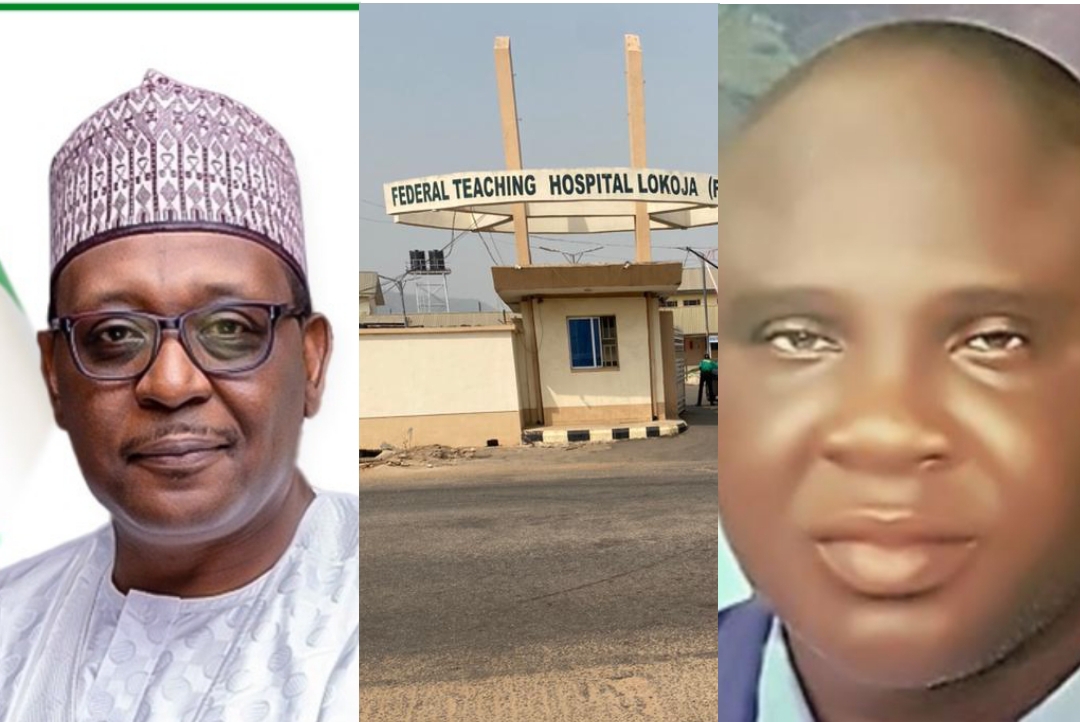
In Lokoja, Nigeria’s’ only confluence capital, where the Niger and Benue rivers merge, a different kind of convergence unfolds, one fraught with despair, exhaustion, and ethical quandaries at the Federal Teaching Hospital Lokoja, formerly known as the Federal Medical Centre Lokoja. This institution, mandated to deliver world class healthcare to Kogi State’s residents and beyond, stands accused of systemic failures that have claimed lives, shattered families, and eroded public trust.
SecretsReporters delved deep into a web of allegations spanning overwork of junior doctors, patient neglect, violent intrusions by political figures, and glaring conflicts of interest, where senior medical professionals allegedly divert resources and patients to their thriving private ventures. This exhaustive probe, drawing from eyewitness accounts, historical records, official statements, and exclusive interviews, uncovers a hospital teetering on the brink, where the pursuit of private gain clashes with public duty, potentially violating Nigeria’s medical ethics and public service codes.
The troubles at Federal Teaching Hospital Lokoja are not new. Tracing back to at least 2018, the facility of the Kogi State Specialist Hospital in Lokoja was plunged into mourning with the death of Doctor Chukwudibe Rosemary, the Head of Department of Internal Medicine, on a Monday that year. Reports from the time detailed how Doctor Rosemary succumbed, allegedly due to exhaustion, overwork, and the non-payment of salaries by the Kogi State Government since February of that year. Compounding the tragedy, another doctor, Idris Nuhu, along with three nurses and a ward attendant, reportedly collapsed under similar strains of relentless duty. The nurses had been on shift since the previous Saturday morning, their workloads exacerbated by a two month strike from the Joint Health Sector Union, which left fewer hands to manage an influx of patients. A hospital staffer, speaking anonymously, connected Doctor Rosemary’s demise to financial woes, recounting how she lamented her omission from the March salary schedule, forcing her to languish in penury, unable to afford her own medications. The informant alleged a dire lack of resources, including no oxygen spanner available to administer lifesaving oxygen and insufficient funds to conduct necessary tests. This whistle-blower urged the state government to prioritize civil servants welfare, highlighting how erratic traffic payment systems adopted by the administration had deepened the crisis.
Fast forward to January 2024, and the hospital became a battlefield when Suleiman Abubakar, the Majority Leader of the Kogi State House of Assembly representing Okene One constituency, allegedly mobilized hoodlums to assault medical staff following the death of his relative. Eyewitnesses described how Abubakar and his entourage broke through the hospitals gates on a Tuesday, unleashing chaos in the Accident and Emergency department. One doctor, recounting the ordeal on Wednesday morning, detailed how the lawmaker tore shirts and beat health workers on duty. The physician explained that their team was reviewing a new patient when the group demanded accountability for a lost patient, whom they later learned was under Abubakars care. Confused and uninvolved, the doctors faced violence, with Abubakar hurling his phone at one and attempting to tear clothing. The assailants destroyed property in the Accident and Emergency unit, assaulting nurses, doctors, and security personnel. The hospital’s Chief Security Officer intervened with a gun, but the mob wrestled it away, firing several shots during the struggle, forcing staff to hide and lock gates. Another doctor, identified as @k_f2d on X (formerly Twitter), confirmed the assault in a series of posts, noting she was directly attacked and a colleague suffered injuries requiring a chest X ray. The lawmaker and his men reportedly beat anyone intervening, including security, while vandalizing hospital assets. When contacted, Kogi State Police Public Relations Officer William Ovye Aya deferred comment, as he was at a recruitment venue, promising to respond later.
Public reactions to the incident poured in on social media and forums, revealing a polarized community. Facebook users reacted to the story with different narratives. Adamu George lamented the hospitals management lessons learned only when high profile cases arise, recalling his 2020 loss of a twenty three year old son due to absent doctors, beds, and attendants. Muazu Sadiq acknowledged potential uncaring behaviour by staff but condemned the lawmaker’s vigilante justice, urging redress through authorities.

In response to the allegations, Suleiman Abdulrazak, the majority leader, denied involvement in shooting or vandalism in a statement issued on January 26, 2024. He accused the hospital of negligence and lies, admitting he visited with two brothers and a colleague but framing the incident as a reaction to delays in treating his father in law, referred from Reference Hospital Okene. Abdulrazak claimed staff removed the oxygen mask without improvisation, leaving the patient unattended for three hours, leading to death. He noted two other negligence related deaths upon arrival, creating a rowdy environment with aggrieved relatives. The lawmaker described finding the Accident and Emergency department padlocked and encountering unresponsive doctors, whom he greeted and introduced himself to but received rude, nonchalant responses. He alleged a chaotic scene involving unidentified men in mufti, staff, and relatives, where one fired shots sporadically, prompting his colleagues security to disarm him. Abdulrazak categorically denied taking thugs, vandalizing facilities, or brutalizing staff, calling it a campaign of calumny. He criticized the hospitals focus on propaganda over quality care, petitioned authorities for investigation, and expressed confidence in justice. The Nigerian Medical Association demanded his arrest and prosecution, amplifying calls for accountability.
SecretsReporters’ own visit to Federal Teaching Hospital Lokoja underscored the dilapidated state. A patient needing dialysis, who walked in with our reporter, was swiftly redirected by three nurses at the Nurses’ Station, including one male and two females, to the Kogi State Specialist Hospital. The nurses openly admitted that many doctors at both facilities (Specialist and FTH) own and manage their private clinics or hospitals, exacerbating resource strains.

The nurses disclosed that the hospital lacked basic admission cards that day, attributed to a health workers strike, but SecretsReporters observed that the only visible development was a massive mosque construction nearly rivaling the administrative building in size. A resident of Lokoja, Ahammed Shaba, lamented this prioritization, questioning how religious structures eclipse medical needs in a facility grappling with inadequate infrastructure.
He said, ‘’I still struggle to understand where exactly we got it wrong, and how wrong we got it. Recently, I noticed a gigantic construction project ongoing at the Federal Medical Centre (FMC), Lokoja, Out of curiosity, I made inquiries and discovered that the structure is a mosque.
‘’This development, however, raises serious concerns. When completed, aside the administrative building, both the mosque and the church within the FMC premises will likely stand as the largest structures in the entire compound in a medical centre that is already grappling with inadequate medical facilities and infrastructure. What this clearly suggests is that Christians and Muslims appear to be competing over who owns the biggest religious structure, rather than prioritising the core purpose of the institution.
‘’More troubling is the placement, the mosque is located close to the main gate, while the church is situated around the residential/administrative area.
‘’This is a federal government establishment, meant to serve all Nigerians regardless of faith, yet religious identity seems to be taking centre stage over institutional functionality.’’

The Mosque under construction
A focal point of SecretsReporters’ uncovering is Adewale Arimiyau Abolore, head of the dialysis unit at the FTH, Lokoja, whose private A4 Consultant Clinic and Dialysis Centre thrives a stone throw away from the FTH. Just opposite the FTH. Incorporated on August 2, 2018, with registration number RC 2635840, its address is No. 6B, J.S.Q. Nigerian Inland Waterways Authority quarters, Lokoja. Abolore serves as proprietor, with activities in medical practice and consultancy. SecretsReporters observed that while the dialysis machine at FTH non-functional with patients being redirected, the A4 boomed with patients spilling outside to decongest interiors. This proximity raises concern and the operation of the A4 owner raises conflict of interest flags against public office holder codes. Even though the Medical and Dental Council of Nigeria’s Code of Medical Ethics, under Rule 49, restricts full time public consultants to one private clinic outside duty hours, mandating in hospital care only at the employing public facility, Rule 42 prohibits enticing patients from colleagues, emphasizing no professional dealings without notice to prior attendants. While the code spells no explicit distance, the Nigerian Constitutions Fifth Schedule Code of Conduct for Public Officers forbids full time officers from managing private businesses except farming to avert conflicts.
SecretsReporters learnt that the dialyses unit of the FTH Lokoja, headed by the owner of the A4 hospital, is one of the units left in terrible conditions.

In an exclusive interview with Doctor Omeiza David Sunday, President of the Association of Resident Doctors at Kogi State Specialist Hospital Lokoja, SecretsReporters conducted as part of probing dual practice, conflicts, self-referrals, neglect, and enforcement gaps, he provided insights from a general perspective. Denying widespread ownership, he noted barely a few doctors at Specialist own private hospitals, roughly one or two percent of total, and emphasized their near constant presence in public duties. He argued few patients in privates come from government referrals, less than zero point one percent, attributing preferences to privacy and accessibility. Overwork, he admitted, affects all due to doctor shortages, with thousands japaing abroad, leading to strikes and low pay
He clarified dual practice as owning versus part time work in privates for tokens outside hours, insisting no inherent conflict if duties are fulfilled. On negligence, he viewed it as universal, not public specific, often misconstrued by the public, like referrals for space shortages being labeled neglect. . ‘’Negligence isn’t just a public hospital concern; it can happened anywhere including private hospitals. It happened in developed Nations and that’s why litigation exists for damages. The Dr that took care of the late Michael Jackson wasn’t a Nigerian. The only misconception in the public most time is that what the masses referred to as negligence isn’t negligence in most case. A patient is referred for lack of space and he goes out there and call it negligence,’’ he said.
He rebuffed claims of most Specialist doctors owning privates as lies, noting none among his seven executives do. He said, ‘’If most Drs have private hospital, how come I don’t have? We are 7 as excos and none of us has private hospital.’’
Doctor Omeiza however mentioned that there is a required distance a private hospital must maintain from a public facility, though unable to recall it precisely, underscoring potential ethical lapses in such close setups.
Messages to former Nigerian Medical Association President Doctor Omede Idris went unanswered. Meanwhile, another NMA former president who reached out informed SecretsReporters that he would not like to speak on the matter. He however admitted that running a private clinic while serving as doctor with a government hospital is illegal for doctors under 10 years of practice.
This mosaic of incidents, conditions, and testimonies paints a hospital in crisis, where junior doctors allegedly endure extended duties beyond norms, fearing reprisals from superiors, a claim Doctor Omeiza contextualized as shared overwork.
FTH Lokoja’s history reveals a transformation fraught with challenges. Originally, the General Hospital Lokoja, built in 1954 by the former Kabba Provincial Government at the Nigerian Inland Waterways Authority headquarters in Adankolo, it relocated in 1958 to its current Government Reserved Area site, half a kilometer away. Upgraded to specialist status in 1984 under Kwara State with additions like four wards, a laboratory X ray building, store laundry complex, and mortuary, it became part of Kogi State in 1991. The Federal Medical Centre Lokoja emerged on November 9, 1999, via an agreement between the Federal Ministry of Health and Kogi State Ministry of Health, starting with eighty six personnel. The mandate emphasized skilled care in a friendly atmosphere sustained by research and training. Late Professor Momoh Anate, the first Medical Director appointed November 12, 1999, oversaw initial renovations, absorbing 252 staff from the old General Hospital in August 2000. Absorbing outdated infrastructure necessitated pulling down old roofs and rebuilding outpatient consulting, pharmacy, children ward, dental, accounts, audit, physiotherapy, casualty, and medical social welfare departments. Miss Thomas Itsemhe A. Val, the first youth corper in 2004, contributed by designing layouts, signposts, labels, wards, offices, and the centres flag.
Under Doctor Dada Gbadebo Eleshin, acting from November 9, 2007, and confirmed in May 2008, manpower shortages were addressed with small scale recruitment of medical officers, nurses, laboratory assistants, health attendants, records assistants, and electricians. Previously, one doctor covered the entire hospital on call and one nurse per ward on afternoons or nights. Locum staff and corps members bridged gaps until larger recruitments in 2010 and 2013.