General News
Another Lie? In INEC’s Form, President Tinubu Submits Another Person Phone Number & Email As His

Secrets Reporters
In the documents submitted to the Independent National Electoral Commission for the 2027 presidential election, President Bola Ahmed Tinubu has again placed his educational and personal particulars under public scrutiny. The Form EC9 (formerly CF001), received and stamped by INEC in July 2026 under the code PR/01 for the All Progressives Congress, contains a sworn declaration in which Tinubu affirms that he is the person seeking election to the office of President and that the particulars given are correct, true and to the best of his knowledge. Yet several entries on the form have already sparked debate, particularly the telephone number and email address provided, alongside the familiar pattern of incomplete educational records that has dogged his candidacies for more than two decades.
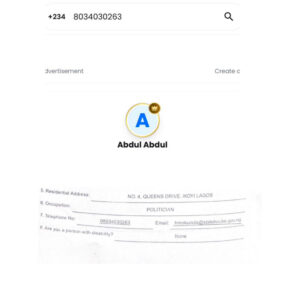
The personal particulars section lists Tinubu’s surname and other names in block letters as TINUBU and BOLA AHMED, date of birth as 29 March 1952, age 74, and birthplace as Lagos. His residential address is given as No. 4, Queens Drive, Ikoyi, Lagos. Occupation is recorded simply as Politician. Under contact details appears the telephone number 08034030263 and the email address hmokunola@statehouse.gov.ng. The latter belongs to a State House domain rather than a personal account while the MTN Phone number belongs to one Abdul Abdul as revealed by checks by SecretsReporters, prompting immediate online commentary that the President has submitted another person’s official contact information as his own. No explanation has yet been offered publicly by the Presidency or the APC for the choice of this email, which appears on official government correspondence channels rather than as a private address belonging to Tinubu himself.

In the section on schools attended and educational qualifications, the spaces for primary and secondary education are either left blank or marked with placeholder entries such as “G000” and “0000.” Only a higher qualification is listed: a B.Sc obtained in 1979. Supporting documents attached include a National Youth Service Corps discharge certificate and a copy of a Bachelor of Science degree. The work experience section records employment with Mobil Nigeria Limited from 1983 to 1992 (reason for leaving: advancement), the Lagos State Government from 1999 to 2007 (legal end of tenure), and the Federal Government of Nigeria from 2023 to date (current). The candidate also declared that he has never been dismissed from the public service.
These details largely mirror the pattern established in Tinubu’s 2023 nomination form, when he similarly omitted primary and secondary school particulars and relied on an affidavit stating that his certificates had been looted by unknown persons during his period of exile in the 1990s. That earlier submission triggered prolonged litigation after the 2023 election. Opposition candidate Atiku Abubakar obtained a United States court order compelling Chicago State University to release Tinubu’s academic records. The university confirmed that a student named Bola A. Tinubu graduated with a Bachelor of Science in Business Administration in 1979, and that the records matched a male student who had attended the institution. However, the physical diploma certificate that Tinubu presented to INEC differed in appearance, seals, signatures and wording from the versions the university said it issued in 1979. University officials stated under oath that they did not have the exact document submitted to INEC in their possession and could not authenticate it as one they had issued. Replacement diplomas, they noted, were sometimes produced by third-party vendors years later and therefore looked different from original 1979 certificates.
Additional discrepancies emerged from the released records. Tinubu’s date of birth appears in some Chicago State University documents as 29 March 1954 or even 1955, two or three years later than the 1952 date consistently used in his Nigerian filings and public celebrations. Admission forms associated with the records also contained claims that he attended Government College Lagos and graduated in 1970, yet historical records show that Government College Lagos was established only in 1974. Critics have further pointed to gender notations and Social Security number anomalies in related transcripts from Southwest College, though the university has maintained that the student who graduated was male and that the name Bola Tinubu is sufficiently unusual in the American context to link the records to the Nigerian president. The Presidency has repeatedly insisted that Tinubu did graduate, that no person can forge a certificate he already earned, and that any differences arise from the legitimate process of obtaining replacement documents. Independent fact-checks, including one by the BBC’s Global Disinformation Team, found no conclusive evidence that the degree itself was fabricated, while acknowledging the persistent mismatches in secondary documentation and personal data.
Nigerian law treats the presentation of a forged certificate as a constitutional disqualification. Section 137(1)(j) of the 1999 Constitution (as amended) states that a person shall not be qualified for election to the office of President if he has presented a forged certificate to the Independent National Electoral Commission. Parallel provisions exist for other elective offices. The Electoral Act requires every candidate to submit personal particulars accompanied by a sworn affidavit affirming that the information is true and that the candidate has fulfilled all constitutional requirements. Section 29 of the Electoral Act (in both its 2022 and subsequent 2026 iterations) mandates that INEC publish these particulars for public scrutiny. Any aspirant from the same party who has reasonable grounds to believe the information is false may file a suit at the Federal High Court seeking a declaration to that effect. If the court finds the false information relates to constitutional eligibility requirements, it may disqualify the candidate. The form itself is completed and sworn by the candidate personally; the declaration language places the burden of accuracy on the individual seeking office. While no provision explicitly states that a telephone number or email address must belong exclusively to the candidate rather than an official or third-party account, the requirement that particulars be “correct, true and to the best of my knowledge” creates an expectation that core identifying and contact information will be the candidate’s own. Submitting an official State House email as a personal contact detail risks being characterised as incomplete or inaccurate information under the same framework that governs educational claims.
Civil society groups have already moved to reopen the matter for the 2027 cycle. One organisation has written to INEC demanding clarification on the secondary school claims and the authenticity of the Chicago State University documents, while another has filed a suit at the Federal High Court seeking Tinubu’s disqualification on grounds of alleged certificate forgery and the absence of a valid secondary school qualification, which the Constitution treats as the minimum educational threshold for the presidency. INEC has maintained that its role is to receive and publish the documents submitted by parties rather than to independently verify the authenticity of every certificate before publication, leaving challenges to the courts and the public.
This episode illustrates the tension between formal constitutional safeguards and the practical difficulties of policing personal history in a political system where documentation from decades past is often incomplete, lost or contested.
Tinubu’s defenders argue that the university’s confirmation of his graduation should settle the matter and that repeated litigation has failed to produce a judicial finding of forgery sufficient to bar him from office. His critics counter that the cumulative discrepancies, mismatched birth years, a secondary school that did not yet exist at the claimed graduation date, a diploma the issuing institution cannot authenticate, blank primary and secondary entries, and now an official rather than personal email, raise legitimate questions about the care with which the highest office is filled. The Form EC9 now on public display for the 2027 election has simply returned those questions to the centre of Nigerian political debate, this time with the added detail of contact information that appears to belong to someone else.